Making the RV You Already Own Easier and Safer to Use
In my previous article on RVing with a disability, I mentioned that my wife’s recent knee replacement got me thinking about accessibility and RVing. Her situation is expected to be temporary, and we certainly don’t need a specially designed accessible RV. What we may need, however, are a few things that make the RV we already own easier and safer for her to use.
That got me thinking about how many other RVers find themselves in a similar situation.
Maybe it’s recovery from surgery or an injury. Maybe knees and hips simply aren’t what they used to be. Balance may have become an issue. Arthritis can make things that were once easy considerably more difficult. Or perhaps someone has a permanent physical limitation but doesn’t need a wheelchair-accessible RV.
For many of these people, giving up RVing isn’t necessary. They may just need to make the RV they already have work a little better for them.
So rather than looking at specially designed accessible RVs, wheelchair lifts, or major conversions, I wanted to see what relatively simple modifications and equipment are available to make an existing RV easier and safer to use.
Start With the Problem You’re Trying to Solve
I think it’s easy to start looking at equipment before really identifying the problem.
Take our situation.
Our biggest concerns right now aren’t whether my wife can move around inside our fifth wheel. They’re whether she can safely get up and down the steps and comfortably use the bathroom.
Someone else might have no trouble with the steps but need something solid to hold onto in the shower. Another person may have difficulty getting up from the toilet or getting in and out of bed.
Before buying anything, take a walk through your RV and think about where the difficulties actually are.
Can you safely get up the steps? Is there something substantial to hold onto? Are there places where you have to step over something? Can you get into and out of the shower safely? Can you get out of bed without struggling? Are rugs, cords, or other items creating trip hazards?
The objective isn’t necessarily to make the entire RV “accessible.” It’s to identify the things that are making your RV difficult or unsafe for you to use and see if there is a reasonable way to improve them.
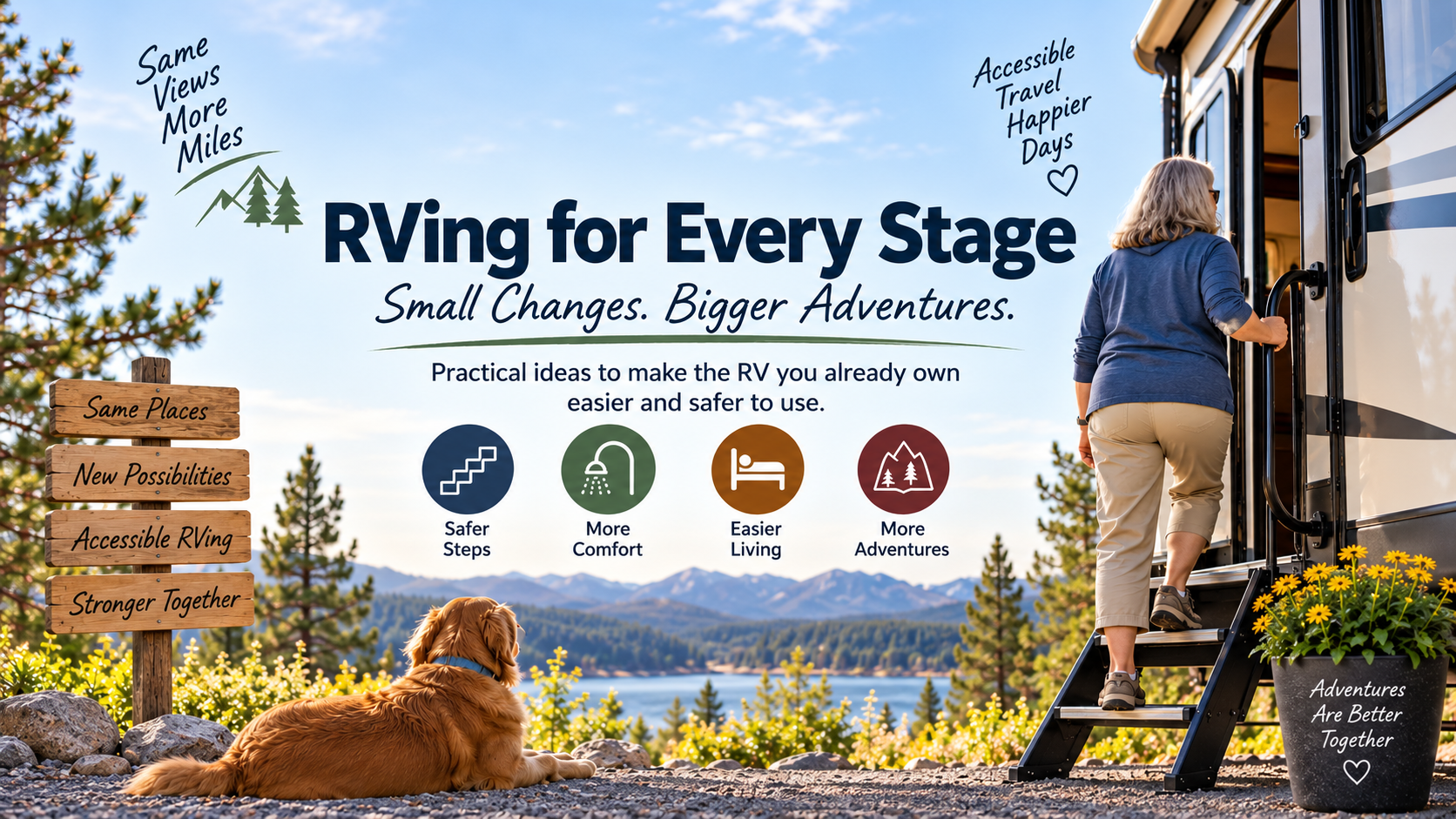
Getting Up and Down the RV Steps
This is probably the first thing many people think about because almost every RV requires climbing steps just to get through the door.
And RV steps aren’t always particularly friendly to someone with mobility problems.
Some are narrow. Some have a fairly large rise between steps. Older fold-out steps can move or bounce as you climb them. The distance from the bottom step to the ground can also change considerably depending upon the campsite.
For someone recovering from knee or hip surgery, dealing with arthritis, or having problems with strength or balance, that can become a significant obstacle.
There are several things worth looking at before assuming you need some type of powered lift.
Newer RV step systems can provide wider and deeper steps and greater stability. Some extend all the way to the ground rather than hanging from the side of the RV.
Lippert’s Solid Step system is one example. The legs extend to the ground and can be adjusted for uneven campsites. Lippert also offers additional handrails and lift-assist equipment for some of these step systems.
There are competing step systems available as well, so it’s worth looking at the different options before deciding what works best for your particular RV.
Another consideration is the height of each individual step. Adding another step can sometimes reduce the distance someone has to raise or lower their leg with each movement.
For someone with a bad knee, that difference could be more important than the overall height of the staircase.
Something Solid to Hold Onto
Steps are only part of the equation.
Take a look at the handrail on your RV.
Many RVs have a folding grab handle beside the entrance door. They’re useful, but depending on the RV, you may have to climb one or two steps before you can comfortably reach it. Likewise, you may have to let go of it before reaching the ground on the way down.
For someone with balance or strength problems, that may not provide enough support.
There are extended RV handrails available that provide something to hold onto through more of the climb. Some step manufacturers also offer handrails specifically designed to work with their step systems.
This is an area where I wouldn’t be satisfied simply knowing that the RV “has a handrail.”
I’d want to know:
Can the person actually reach and hold onto it during the entire portion of the climb where they need assistance?
That is a much different question.
Don’t Overlook the Entrance Itself
Once you’re up the steps, there can still be obstacles at the doorway.
Some RV entrances have raised thresholds. Screen-door frames can create another place to catch a foot. Floor mats can move. Shoes left beside the entrance can become trip hazards.
None of those things normally attract much attention.
But when someone is using a cane or walker, recovering from surgery, or simply isn’t as steady as they once were, a relatively small obstacle can become a much bigger problem.
This is probably one of the easiest areas to improve because many of the solutions don’t require buying anything.
Sometimes accessibility starts with simply removing obstacles.
Moving Around Inside the RV
RVs aren’t known for having a lot of extra floor space.
Furniture, kitchen islands, tables, chairs, slide-outs, and storage areas can create narrow pathways.
Someone who has never thought twice about squeezing between the kitchen island and a chair may suddenly find that difficult while using a walker or cane.
Again, the answer doesn’t necessarily require remodeling the RV.
Moving a chair, relocating a small table, keeping commonly used items within easy reach, and eliminating things stored on the floor may make a considerable difference.
This is also a good time to look at rugs.
Small throw rugs can move or bunch up and become a trip hazard. The same applies to electrical cords and other items crossing walking areas.
Sometimes making an RV easier to use is as much about what you remove as what you add.
The Bathroom Deserves Special Attention
If I were evaluating an RV for someone with limited mobility, the bathroom would be high on my list.
RV bathrooms are small. Showers frequently have a raised lip that has to be stepped over. Floors can become slippery. There may be very little room to regain your balance if you start to fall.
There are a number of relatively simple products that could help, depending upon the individual.
A shower seat can allow someone to bathe without standing for an extended period. Non-slip shower surfaces can improve footing. Toilet-assist rails can help someone lower and raise themselves.
Grab bars can also make a significant difference, but installing one in an RV deserves some thought.
An RV wall isn’t necessarily constructed like a residential bathroom wall. I would not simply screw a grab bar into the paneling and assume it will support someone’s weight.
A safety grab bar needs to be attached to something structurally capable of handling the load placed on it.
This is one modification where knowing what’s behind the wall matters.
Getting Into and Out of Bed
The bedroom is another area that may not seem like an accessibility issue until it becomes one.
RV beds can be high. Some are surrounded by walls or cabinets. In some floorplans, one person may have to climb partially over the other to get into or out of bed.
Someone recovering from surgery or having strength or balance issues may suddenly find that difficult.
Depending upon the RV, relatively simple changes might help.
A properly positioned assist handle could provide something to hold onto while getting up. Changing mattress height could make transfers easier. Rearranging items around the bed might provide more room.
Again, I’d concentrate on solving the specific problem rather than adding equipment simply because it’s marketed for accessibility.
What About Outside the RV?
The campsite itself deserves the same evaluation.
A perfectly accessible RV isn’t much help if the person has difficulty getting from the truck to the camper.
Uneven gravel, tree roots, muddy areas, steep campsite slopes, hoses, electrical cords, and outdoor rugs can all create problems.
Site selection may become more important than it was previously.
A reasonably level site close to the campground facilities may be worth considerably more than the prettiest site in the campground.
This is another area where the needs of someone with a temporary limitation may be very similar to those of someone dealing with a permanent mobility issue.
Temporary Doesn’t Mean You Should Ignore Safety
This is something our current situation has made me think about.
When a limitation is temporary, it would be easy to say, “We’ll just deal with it for this trip.”
I’m not convinced that’s a particularly good approach.
If a relatively inexpensive piece of equipment makes it significantly safer for someone to get into the RV, shower, or move around the campsite, it may be money well spent even if it’s only needed for a few months.
A fall could turn a temporary recovery into a much bigger problem.
At the same time, I wouldn’t spend thousands of dollars permanently modifying an RV to solve a problem that is expected to disappear in several weeks.
The solution should fit both the person’s needs and how long those needs are expected to last.
When Simple Modifications Aren’t Enough
There is obviously another level of RV accessibility beyond what I’m discussing here.
Wheelchair platform lifts, widened doors, roll-in showers, lowered countertops, modified floorplans, and RVs specifically designed around wheelchair accessibility are available.
Those are significant modifications and deserve a discussion of their own.
For this article, I’m concentrating on RVers who can continue using their existing RV but need some help making it safer and easier to use.
I’ll take a closer look at the equipment and RVs available for people who require major accessibility accommodations in a separate article.
Some Companies and Products Worth Investigating
There are many products available, and what works for one person or RV may not work for another. Here are some of the companies and types of equipment I came across while researching this article.
BraunAbility: I am familiar with BraunAbility because I worked with them when helping my sister obtain a van equipped with a wheelchair lift. They offer a variety of mobility products, including equipment that can be used in RV applications.
RV steps and entry systems: Lippert Solid Step is one example of a ground-supported step system designed to provide greater stability. There are competing systems worth investigating as well.
Roll-A-Ramp offers portable and configurable ramp systems that can be adapted for various applications, including RV access. A ramp system can be considerably more expensive than simply changing steps or adding a handrail, but for a full-time or seasonal RVer with a long-term mobility issue, it may be an option worth investigating.
Extended handrails: Several manufacturers offer handrails designed to provide support farther down the RV steps rather than only at the doorway. Lippert is one source, and there are numerous aftermarket options available.
Additional entry steps: Adding a step or changing the step system may reduce the height between individual steps, making entry and exit easier for someone with limited knee or hip movement.
Bathroom assistance: Shower seats, toilet-assist rails, non-slip surfaces, and properly installed grab bars can make a significant difference. There are many sources for this type of equipment.
The important thing to remember with permanent grab bars and railings is how they attach to the RV. RV walls generally don’t have the same substantial framing found in a house. Before trusting a railing with someone’s weight, make sure it is properly anchored to something capable of supporting it. Professional installation may be worth considering.
Bed assistance: Handles and rails are available to help someone safely get into and out of bed. As with bathroom grab bars, make sure anything intended to support a person’s weight is properly secured.
Portable assistance equipment: If the mobility limitation is temporary, portable equipment that can be removed when it is no longer needed may make more sense than permanently modifying the RV.
I’m deliberately not recommending particular products. There is enough variation among RVs and individual physical needs that anyone considering accessibility or safety equipment should research what’s available, how it will fit their RV, and how it needs to be installed before making a decision.
If you have an RV dealer or service center you work with and trust, they can also be a valuable resource when determining what can safely be installed on your particular rig.
Look at Your Own RV Differently
Maybe the biggest takeaway for me so far is that accessibility doesn’t always require a specially designed RV.
Walk through the camper you already own and look at it from the perspective of someone who doesn’t move as easily as they once did.
Look at the first step.
Look at where the handrail starts and ends.
Look at the shower threshold.
Look at the toilet.
Look at the height of the bed.
Look at the things someone has to step over or squeeze around.
You may find that one or two relatively simple changes could make the difference between someone struggling through a camping trip and being able to comfortably enjoy it.
In our case, we’re going to find out shortly what my wife actually needs to safely use our fifth wheel as she continues recovering from her knee replacement.
Our main concern is the entry steps. Thankfully, we have a handrail that she can use both going in and coming out. Our shower has a low threshold and a seat, so we think she should be okay there.
Before making the trip, we’ll likely do a test at home to make sure she can comfortably and safely get in and out of the RV. The last thing she would want is to get to the campground and discover that she’s essentially confined to the rig for the week.
Taking the time to do some research is probably the best recommendation I can give. We constantly make decisions about how we use our RVs and what equipment we need. When physical limitations enter the picture, those decisions become even more important.
Do the research, look carefully at your own situation, and find the solution that works for you and the RV you already own.
Enjoy Rick's Ramblings?
If you found this post helpful or interesting, subscribe to receive an email when new posts are published.