Is RVing Getting Too Expensive?
Inflation, whether it’s brought on by new or higher taxes, tariffs, world and national politics, price increases, or any number of other factors, is affecting all of us.
My wife and I are both retired. Although we have part-time jobs to keep active and bring in some pocket money, we live primarily on a fixed budget. Like everyone else, when the cost of one thing goes up, there is less money available for something else.
RVing is no exception.
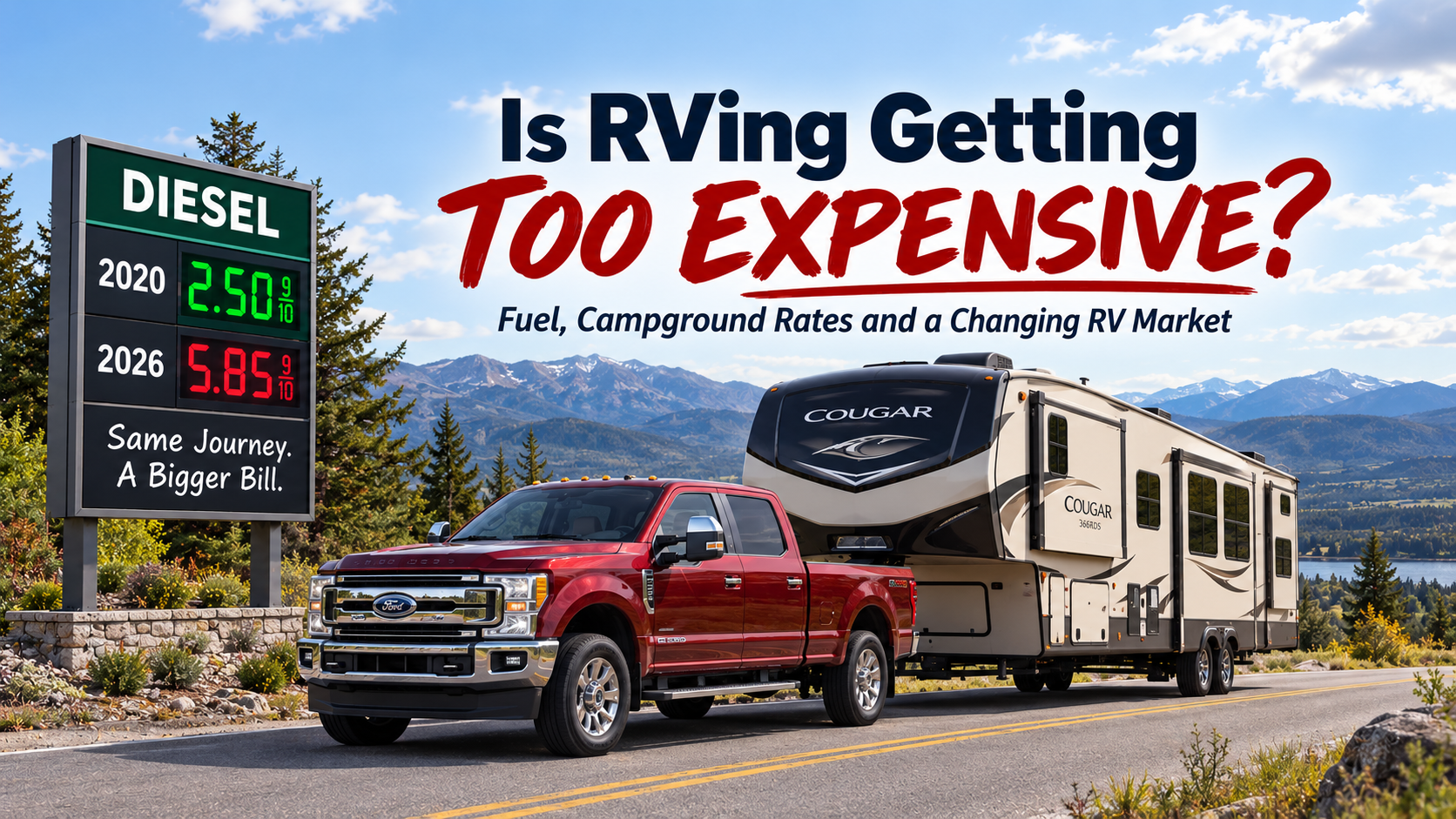
When we bought our RV in 2020, diesel was generally running between $2.30 and $2.75 a gallon. This week, we’re seeing prices hovering just below $6.00.
That has an impact on our willingness to take longer trips.
One of our favorite things to do is head south during the winter. For us, that’s roughly 1,200 miles each way. Our truck gets around 9 miles per gallon when towing our fifth wheel.
At $2.50 a gallon, 1,200 miles costs about $333 in diesel. At $5.85 a gallon, that same trip costs about $780.
Double that for the round trip and we’re looking at approximately $667 in fuel in 2020 compared with $1,560 today — almost $900 more just to get there and back.
That’s $900 that isn’t available for campground fees, restaurants, attractions, or anything else we might want to do while we’re traveling.
And fuel isn’t the only thing that has become more expensive.
Campground rates have gone up. Food costs more. Insurance costs more. Repairs and maintenance cost more. Add all of those increases together and eventually they begin to affect how often people travel, how far they go, and perhaps whether they continue RVing at all.
RV Sales Are Already Slowing
There are indications that the RV industry is feeling some of these economic pressures.
According to the RV Industry Association’s June 2026 shipment report, total RV wholesale shipments through June were down 14.2% compared with the same period in 2025. Fifth-wheel shipments were down even more, 19.9%.
The RV Industry Association subsequently lowered its 2026 forecast to a midpoint of approximately 314,000 RVs, an 8.2% decline from 2025. Among the factors cited were tightening household budgets, higher financing costs, uncertainty, and continued inflationary pressure.
That doesn’t mean diesel prices alone are responsible for declining RV sales. Interest rates, RV prices, inflation, and economic uncertainty all play a role.
But I have to believe that someone considering spending a significant amount of money on a large fifth wheel and the diesel truck needed to pull it is also thinking about what it’s going to cost to actually use them.
What Is Happening at the Campgrounds?
The campground industry is showing some changes as well, although the picture isn’t as simple as saying people have stopped camping.
In fact, the June 2025 OHI and Campspot Data Dig report found that overall campground occupancy during the previous 365 days increased about 2%, from 34.1% to 34.9%. June 2025 itself was essentially flat compared with June 2024.
Other campground data, however, suggests travelers may be changing how they make reservations.
RoverPass reported that reservations across its platform declined 1% in 2025, the first annual reservation decline in its platform’s history. At the same time, campground revenue increased 5.2%. RoverPass also reported that long-term stays of 28 nights or more increased 19.1%.
Those numbers are interesting. Are more RV owners choosing seasonal or long-term stays rather than towing their RVs thousands of miles each year? Are higher campground rates contributing to increased revenue despite fewer reservations? There are probably several factors involved.
Regional differences are showing up as well. Reporting based on Campspot data found that the Rocky Mountains and High Plains region experienced roughly an 8% decline in reservations, while campers were also making more reservations within 60 days of arrival rather than booking as far in advance.
Again, we can’t say fuel prices caused that decline. But it makes me wonder whether some RVers are reconsidering those long-distance trips.
If you’re traveling without the RV, you can fly or drive a more fuel-efficient vehicle and stay in a hotel or VRBO. When you’re pulling a large fifth wheel at 9 miles per gallon with diesel approaching $6 a gallon, the economics change considerably.
People Are Still Camping
Interestingly, the number of people camping hasn’t collapsed.
According to KOA’s 2026 Camping & Outdoor Hospitality Report, more than 52 million North American households camped during 2025, and participation remained above pre-pandemic levels.
So people clearly haven’t abandoned camping.
What may be changing is how they camp: how far they travel, how long they stay, when they make reservations, and how much they’re willing to spend getting there. Are there more full time people who have downsized from a traditional home to living in a RV.
It will be interesting to see what those numbers look like for 2026, particularly if high fuel prices continue.
Something I’ve Noticed Myself
There is another change I’ve noticed, although this one is purely my own observation.
I’ve booked RV travel all over the country during the past six years. Recently, I seem to be finding more available RV sites in the warmer parts of the country during the winter than I remember seeing several years ago.
Does that mean fewer people are snowbirding?
Maybe, but I don’t have the numbers to prove it.
Economics could certainly be part of it. Spending several months at an RV resort isn’t inexpensive, and neither is towing or driving an RV a thousand miles or more to get there.
Demographics could be another factor. Baby boomers have made up a significant portion of the RV population, and as my generation gets older, some people inevitably reach the point where health or age makes extended RV travel more difficult.
There may be other explanations as well.
But from what I’ve personally seen while making reservations, something appears to be changing.
Where Does the RV Industry Go From Here?
Inflation, regardless of its source, is having an effect on the RV world. The question is what happens next.
Will we see manufacturers put more emphasis on smaller and lighter RVs that require less fuel to tow?
Will more RV owners choose seasonal sites and travel shorter distances rather than taking long cross-country trips?
Will campground operators eventually have to hold down rates or offer more discounts to attract campers?
Could struggling campgrounds close if occupancy begins to decline?
And if RV sales continue to fall, will manufacturers reduce production and employment?
I don’t know the answers, but I think the industry will have to adapt if the cost of RV ownership and travel continues to increase.
For most of us, RVing is discretionary spending.
When household budgets get squeezed, housing, food, utilities, medical expenses, and other necessities come first. Vacations and recreational spending are much easier to cut.
My wife and I aren’t ready to give up RVing. We still enjoy it too much.
But when a winter trip that once cost around $667 in diesel now costs more than $1,500 just to make the round trip, we’re going to think harder about whether we make that trip. We are looking at a trip to the southwest next fall and due to the distance of the tow, fuel prices are a deciding factor.
I suspect we’re not the only RV owners doing the math.
Enjoy Rick's Ramblings?
If you found this post helpful or interesting, subscribe to receive an email when new posts are published.