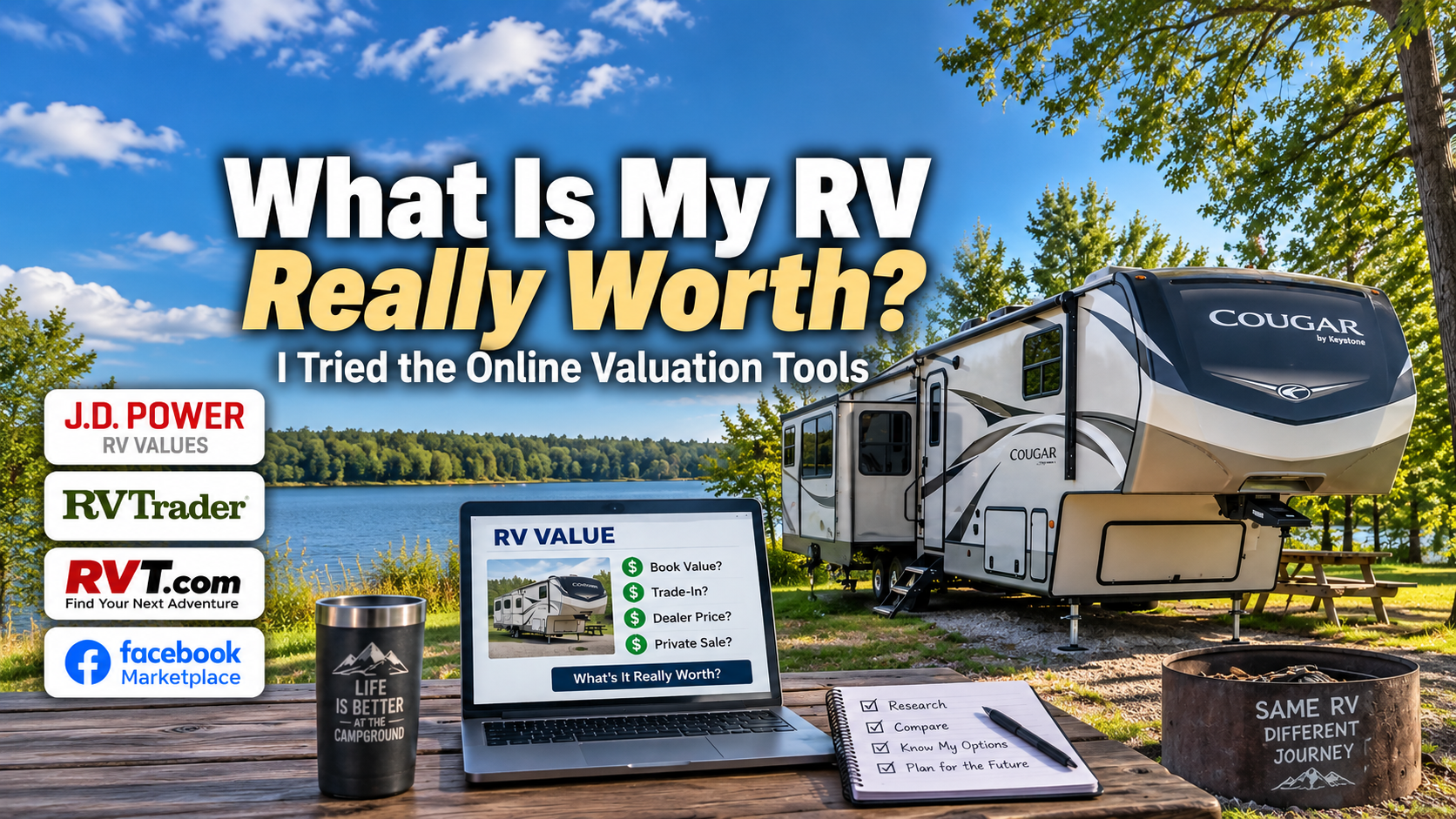
What Is My RV Really Worth? I Tried the Online Valuation Tools
If you own an RV long enough, eventually you’re probably going to wonder what it’s worth.
Maybe you’re thinking about selling it, trading it for something different, or you’re simply curious about how much value it has lost since you bought it.
That’s something we’ve been wondering about our 2020 Keystone Cougar 366RDS fifth wheel. We’re not necessarily ready to sell it today, but knowing what it’s worth is an important part of deciding what we might do in the future.
Finding that number isn’t as simple as I expected.
Unlike cars and trucks, there doesn’t seem to be one number you can look up and confidently say, “That’s what my RV is worth.” There are online valuation guides, dealer prices, private-party asking prices, trade-in values, and actual market conditions to consider.
So I decided to try several of the online tools and see what I could learn.
J.D. Power
One of the first places I tried was J.D. Power RV Values.
If you remember using NADA guides to look up vehicle or RV values, J.D. Power acquired the NADA Guides business several years ago. They’ve been around a long time and are probably one of the better-known names in vehicle valuations.
I tried using the site to value our fifth wheel and wasn’t particularly impressed with the experience. I entered our RV using the VIN, but the site wasn’t able to give me an estimated value.
Maybe it was simply a problem with our particular RV or a glitch in the system. Given J.D. Power’s long history in vehicle valuations, I wouldn’t dismiss the site based solely on my experience, but it wasn’t very useful to me in this case.
RV Trader
Next I tried RV Trader’s RV Value Guide.
This one was simple to use.
RV Trader’s valuation tool works in collaboration with J.D. Power, so I wouldn’t consider the two completely independent sources of valuation information. But RV Trader has another advantage: you can also search its listings to see what similar RVs are actually being advertised for.
That gives you another piece of the puzzle.
A valuation tool can tell you what an RV theoretically should be worth. Looking at actual listings tells you what dealers and private sellers are currently asking for similar rigs.
RVT.com
I also tried RVT.com.
Rather than looking for a calculated value, I searched for our model from the buy side of the website. I found it to be a good source of comparable RVs currently being offered for sale.
If you can find several RVs that are the same year, make, and model as yours, you can start comparing asking prices. If there aren’t many exact matches, expand the search to a year older and a year newer.
Then look beyond just the price.
Is it being sold by a dealer or a private owner? What condition is it in? What options does it have? Where is it located?
All of those things can affect value.
Of course, there’s an important limitation to using advertised RVs as comparables.
Asking price isn’t selling price.
Someone can advertise a $30,000 RV for $40,000. That doesn’t suddenly make it worth $40,000.
Looking at several comparable RVs, however, can give you a pretty good idea of the range in which sellers are trying to compete.
Facebook Marketplace
Facebook Marketplace is another place worth checking, particularly if you’re considering a private sale.
I wouldn’t consider Marketplace an official valuation source, but it can show you what other private sellers in your area are asking for similar RVs.
Location matters.
If I’m trying to sell an RV in Minnesota, I’m particularly interested in what someone can buy within a reasonable driving distance of me. A comparable RV advertised 1,500 miles away isn’t necessarily competing with mine in the same way one located 50 miles away is.
Again, don’t look at the highest asking price you can find and decide that’s what your RV is worth. Look at several comparable rigs and try to identify a realistic range.
What About Camping World?
We also tried the Camping World RV valuation page.
I wasn’t impressed with that process either.
After asking for quite a bit of information, instead of providing an estimated value or even a range, it took us to a screen to set up an appointment.
I understand why Camping World would want to inspect an RV before making an actual purchase or trade-in offer. Condition can make a significant difference in value, and they can’t determine that from a computer screen.
But I think they could at least provide a preliminary range based on the information entered.
For someone who is simply trying to determine what an RV might be worth and isn’t necessarily interested in buying another one, the prospect of making an appointment and potentially sitting through a sales pitch isn’t particularly appealing.
That’s not what I was looking for. I wanted information that would help us decide what we wanted to do before talking to someone about selling or trading the RV.
Good Sam
Good Sam’s RV Valuator also provides a way to begin the valuation process.
However, Good Sam’s process ultimately connects back into the Camping World dealer network.
Since we’d already tried the Camping World process and it wasn’t what we were looking for, I didn’t see much reason to go through essentially the same process again.
If you’re ready to sell or trade your RV and want a dealer offer, that may be perfectly useful.
If you’re simply researching what your RV is worth, there are other places I’d try first.
Book Value, Asking Price and Selling Price Aren’t the Same Thing
One thing became pretty obvious while doing this research: there are several different numbers that can be called an RV’s “value.”
Book value is what a valuation service estimates the RV is worth.
Dealer asking price is what a dealer hopes someone will pay.
Private-party asking price is what another RV owner hopes to receive.
Trade-in value is what a dealer is willing to allow toward another RV.
And then there is actual selling price — what someone ultimately hands over the money to buy it for.
Unfortunately, that’s usually the hardest number for the rest of us to find.
That’s why I wouldn’t rely on any single source.
The Market Matters Too
RV values don’t exist in a vacuum.
According to J.D. Power’s 2026 Q2 Recreational Vehicle Market Report, fifth-wheel values declined another 2% during the second quarter of 2026 after falling 3% during the first quarter.
That fits with some of the other things I’ve been looking at recently regarding declining RV shipments, higher fuel costs, inflation, and tighter household budgets.
If fewer people are shopping for large RVs, sellers may eventually have to adjust their expectations.
Timing matters as well. Trying to sell an RV in Minnesota in the middle of winter isn’t the same as putting one on the market in the spring when people are starting to think about camping.
Why Knowing the Value Matters Even If You Aren’t Selling
After trying these different sources, I think the biggest lesson is that knowing what your RV is worth is useful even if you aren’t ready to sell it.
Use the tools that are available. Get several numbers. Look at comparable RVs for sale. Then compare what you find with what you still owe.
That last part can be extremely important.
Being underwater — owing more on the RV than you could reasonably sell or trade it for — can have a huge impact on what your next step will be.
Take our situation.
Based on what we’re seeing, if we decided to sell our fifth wheel outright today, we would likely owe more on the loan than we could sell the RV for. That means selling it wouldn’t simply put money in our pocket. We would have to come up with enough cash to pay the difference between the selling price and the remaining loan balance in order to satisfy the loan.
That’s a very different financial decision.
On the other hand, knowing that number gives us options. We can continue using the RV and paying down the loan. We can make additional principal payments if we decide selling sooner is important. Or we can simply wait until the loan balance and the RV’s market value get closer together.
Without knowing approximately what the RV is worth, we’d be making those decisions in the dark.
So What Is My RV Really Worth?
I don’t think any one website can answer that question with complete confidence.
My approach would be to use an online valuation tool as a starting point, then look at comparable RVs on RV Trader, RVT.com, Facebook Marketplace, and other marketplaces.
Don’t focus on one number.
Look for a range.
Then be realistic about the condition of your RV, the local market, the time of year, and whether you’re selling privately or trading it to a dealer.
Ultimately, an RV is worth what someone is willing to pay for it.
The online tools won’t give you a perfect answer, but they can give you enough information to make a much better decision about what comes next.
Enjoy Rick's Ramblings?
If you found this post helpful or interesting, subscribe to receive an email when new posts are published.