Fuel Prices: Up Like a Rocket, Down Like a Feather
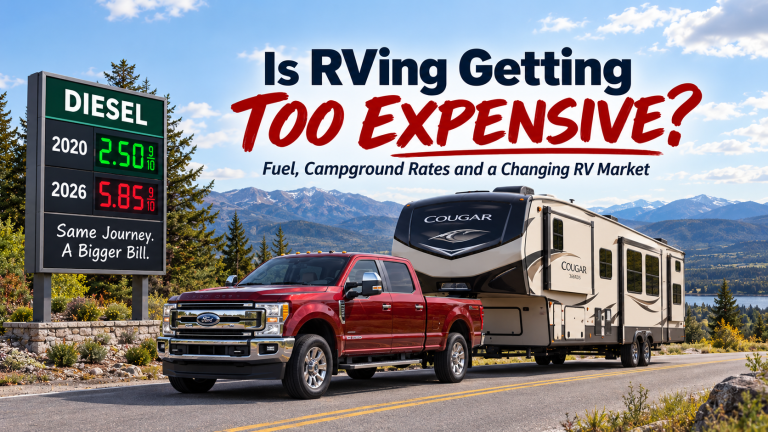
It seems like every time we start planning another RV trip, fuel prices become a bigger part of the conversation. Lately, watching diesel climb again got me thinking about something that has frustrated me for years. Fuel prices shoot up, eventually come back down, but rarely seem to make it all the way back to where they started. Then another increase comes along and the whole process starts over from a higher price. I decided to dig into the numbers to see whether my perception matched reality.
Crude oil is usually the first thing we hear about when fuel prices rise, so that’s where I started. I went back through historical crude oil, gasoline, and diesel prices looking for periods when crude oil was selling for roughly the same amount. If crude oil is such a major factor in the price of fuel, I wondered how gasoline and diesel prices compared when the price of crude was nearly identical.
One comparison really stood out.
Almost Exactly the Same Crude, Very Different Fuel Prices
During the fourth quarter of 2011:
Crude oil: $103.60 per barrel
Regular gasoline: $3.32 per gallon
Diesel: $3.84 per gallon
During the second quarter of 2022:
Crude oil: $103.20 per barrel
Regular gasoline: $4.21 per gallon
Diesel: $5.31 per gallon
Crude was actually about 40 cents per barrel cheaper in the 2022 comparison.
Yet gasoline was about 89 cents per gallon more expensive, and diesel was about $1.47 per gallon more expensive.
That doesn’t mean somebody was simply pocketing the difference. It does show that saying “crude oil is $100 a barrel” doesn’t come close to explaining the price we’re paying at the pump.
There Is More to It Than Crude Oil
As I dug into this, I discovered pretty quickly that I could go down a very deep rabbit hole.
Crude oil is only part of the retail price. Refining costs, refinery capacity, inventories, transportation, taxes, seasonal fuel requirements, supply and demand, and other factors all affect what we eventually pay.
I also discovered that economists have studied another part of what has frustrated me for years. They even have a great name for it:
“Rockets and feathers.”
The basic idea is that fuel prices can rocket upward when costs increase but feather downward when costs decline.
There are legitimate economic explanations for some of this. Fuel already in the distribution system has a cost. Stations also have to consider what their next load will cost. Wholesale markets react to what crude oil and refined products are expected to cost in the future, not just what they cost today.
So I’m not suggesting that a $20 drop in crude today should automatically mean gasoline is 48 cents cheaper tomorrow.
What frustrates me is how different the two directions seem to work.
Crude jumps $20, and the price at the pump seems to react almost immediately.
Crude falls $20, and we’re told it will take time for those savings to work their way through the system.
There are economic reasons for both. That doesn’t make it any less irritating when you’re standing at the diesel pump.
Maybe We Get Used to It
There’s another piece of this that I find interesting.
When prices are climbing, we pay attention. We complain. We watch the signs as we drive by. Some people will drive across town to save ten cents a gallon.
But after we’ve been paying $4.50 for a while, seeing $3.75 starts looking pretty good.
The problem is that before the increase, we may have been paying $3.00.
Our point of reference has changed.
There is economic research suggesting that consumer behavior plays a role. People tend to search more aggressively for lower prices when prices are rising. When prices are falling, that urgency diminishes.
I’m not suggesting that explains everything, and I’m certainly not going to turn this into an economics paper.
I just know what it looks like from my side of the pump.
For RVers, These Aren’t Small Numbers
This is where the discussion becomes very real for us.
When we’re pulling our fifth wheel, we’re getting somewhere around 9 miles per gallon.
Take a 1,200-mile trip. At 9 MPG, we’ll burn about 133 gallons of diesel one way.
A $1 increase in diesel adds roughly $133 each way, or about $266 round trip. A $1.50 increase adds about $200 each way, or $400 to the trip.
That’s money that isn’t being spent at a campground, restaurant, attraction, or somewhere else along the way.
And that’s why I pay attention to fuel prices.
Like many retirees, our income comes from a combination of pensions, Social Security, and investments. Some of that income may increase over time, but that doesn’t necessarily mean it keeps pace with what we’re actually spending.
Our investments give us another source to draw from, but that isn’t free money either. Increasing our withdrawals means taking more money out of the investments that are supposed to help support us throughout retirement.
At some point, something has to give.
Unfortunately, the fuel prices we’re seeing now are beginning to affect our travel plans. Trips that made financial sense at one fuel price can look considerably different when diesel climbs another dollar or two per gallon.
For now, that means we’re taking another look at where we go, how far we travel, and what some of those trips are really going to cost.
Hopefully fuel prices will come back down.
I’m not holding my breath.
Understanding It Doesn’t Make It Less Frustrating
I started looking at these numbers because I was frustrated, not because I had already decided what the answer was.
The research actually convinced me that the relationship between crude oil and retail fuel prices is considerably more complicated than I thought. There are legitimate reasons why $100 crude in one year doesn’t necessarily produce the same gasoline or diesel price as $100 crude in another year.
But understanding the economics didn’t make my original frustration disappear.
Fuel prices rise. Eventually they retreat, and we breathe a sigh of relief because they’re finally coming down.
Then one day you realize that the price you’re now happy to pay would have made you angry a couple of years earlier.
Maybe that’s economics.
Maybe that’s human nature.
It’s probably some of both.
Either way, when you’re pumping 30 or 40 gallons of diesel into a truck, “at least it’s cheaper than it was last month” isn’t always very comforting.