Trailer Lights: Finding the Problem Before You Hit the Road
My wife, Pat, and I volunteer and help raise money for the Cystic Fibrosis Foundation. One of the fundraisers Pat participates in each fall involves selling mums. Another CF fundraiser is able to purchase them wholesale and resell them, with the profits going to support the fight against cystic fibrosis.

The only catch for us is that the mums have to be picked up in Wisconsin and brought back to Minnesota. These aren’t little plants, either. They come in beautiful pots that are probably two feet in diameter, so moving a bunch of them requires a trailer.
What does any of this have to do with trailer lights?
Bear with me. I’m getting there.
I called a friend who has an enclosed trailer and asked if we could borrow it for a weekend to pick up the mums Pat had sold. He told me I could use it anytime, but since we’d be putting some highway miles on it, he wanted to replace the tires first. He had been meaning to do it anyway, and our request gave him the push he needed.
He made the tire appointment, hooked up the trailer and, fortunately, checked the lights before leaving.
Nothing.
He spent more than an hour trying to troubleshoot the problem and wasn’t getting anywhere.
If you’ve owned trailers for any length of time, you probably know where this is going. Trailer light problems can be some of the most frustrating electrical problems to chase down. They can confound the best of us.
I eventually went over to see if I could help. We worked our way through the system but still couldn’t find the problem.
Fortunately, I have a set of portable trailer lights, so we came up with a way to temporarily mount those on his trailer. That would allow him to safely get the trailer where it needed to go until the original wiring could be properly diagnosed and repaired.
Trailer Lights Aren’t Optional
If you’re towing a trailer, you need working lights.
The people behind you need to know when you’re braking and when you’re going to turn. Depending on the size of your trailer, they may also have a limited view of what’s happening on the road ahead of you.
For us, checking the trailer lights is one of the last things we do before pulling out. Thankfully, most of the time everything works.
But what happens when you’re packed, hooked up and ready to leave and suddenly discover that the trailer lights aren’t working?
That’s when having a basic understanding of the system can save you a lot of frustration.
I’ve owned several trailers over the years and used them during all four seasons, so I’ve dealt with my share of trailer light problems. One thing I’ve learned through trial and error is to troubleshoot systematically rather than jumping from one possibility to another.
Start at the tow vehicle and work your way toward the back of the trailer.
A small multimeter is one of the most useful tools you can carry. You don’t need an expensive one. A basic meter allows you to check for voltage and continuity and can quickly help determine whether the problem is with the tow vehicle or the trailer.
Trailer Light Troubleshooting
If your trailer lights aren’t working, here’s a basic order to follow:
- Start with the tow vehicle. Test the vehicle’s trailer connector with a test light or multimeter to make sure the proper signals are reaching the plug. If they aren’t, check the tow vehicle’s trailer-light fuses.
- Check the connection. Make sure the trailer plug is fully seated. Look for dirt, corrosion, bent pins or other damage on both the vehicle and trailer connectors.
- Check the ground. A poor ground connection can cause strange problems or make several, or even all, of the trailer lights stop working. Check the ground connection at the plug and where it attaches to the trailer.
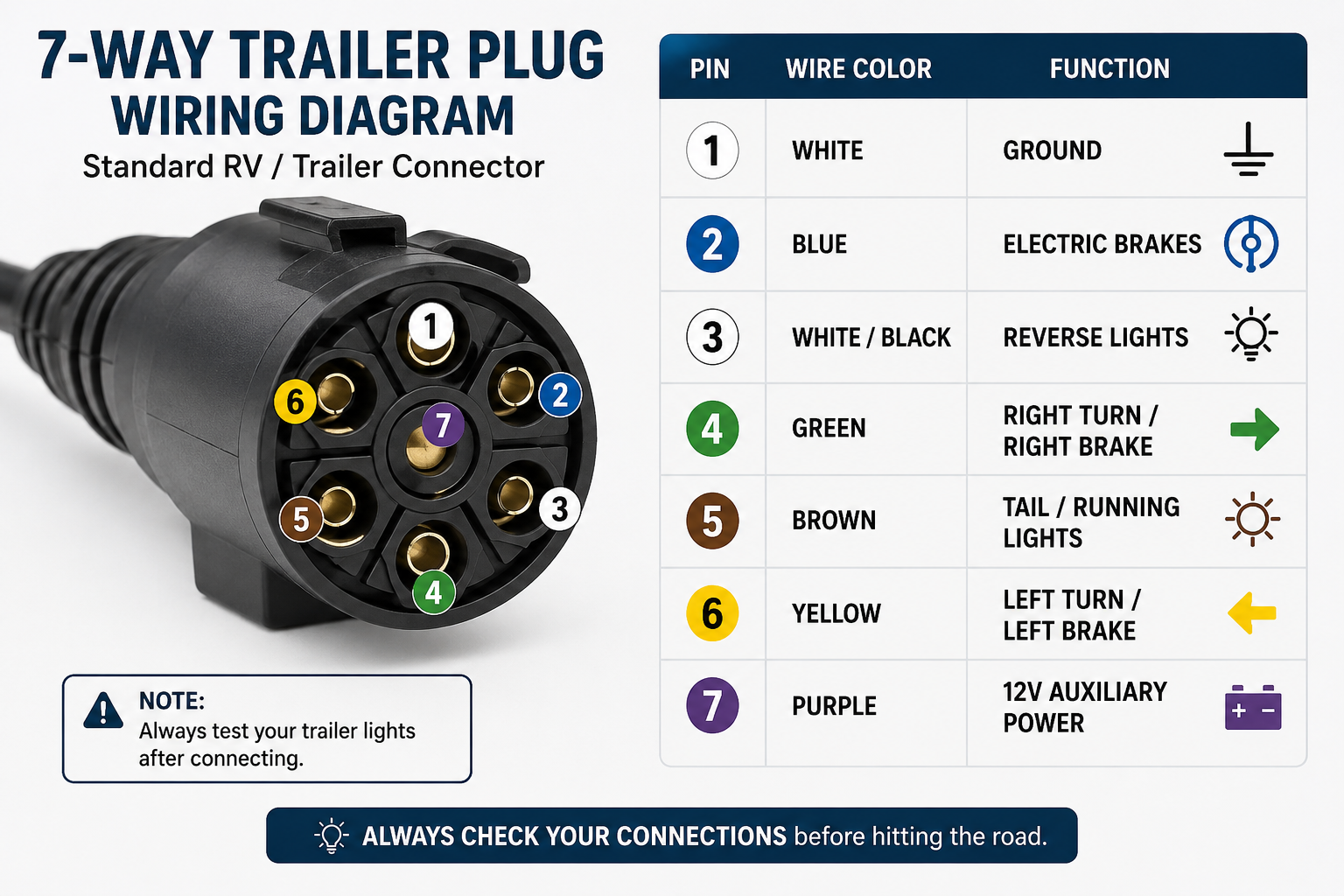
- Test the trailer separately. If you know the pin configuration of your trailer connector, you can use a fused 12-volt source to test individual lighting circuits. Make sure you know which terminal you’re powering before doing this.
- Check trailer fuses if equipped. Some trailers have additional fuses or junction boxes that should be inspected.
- Inspect the lights. Check bulbs, LED fixtures and connections for damage, corrosion or loose wiring.
- Follow the wiring. If one circuit isn’t working, trace that wire from the front of the trailer toward the lights. Look for cuts, pinched wires, damaged splices and loose connections.
- Work from front to back. Test at different points along the circuit. When you find the point where you had power before but don’t have it afterward, you’ve narrowed down where the problem is.
YouTube can also be a great resource. Search for your particular trailer connector or problem, and there’s a good chance someone has made a video showing how to diagnose it.
Consider Carrying Emergency Trailer Lights
We actually already carry a set of portable trailer lights with us when we’re traveling.
Our e-bikes ride on a rack at the rear of our fifth wheel, and depending on how they’re positioned, they can partially block the view of the trailer’s tail lights. We use the portable lights to make sure the vehicles behind us can clearly see our brake lights and turn signals.
Having those lights available also gave us a temporary solution when my friend’s trailer lights wouldn’t work.
There are both wired and wireless versions available. Some plug directly into the tow vehicle’s trailer connector and communicate with temporary lights mounted on the back of the trailer. Depending on the model, the lights may attach magnetically or with another temporary mounting system.
They aren’t a substitute for repairing your trailer’s original lighting system. Think of them as an emergency option that may allow you to safely get the trailer home or to a repair facility rather than being stranded because of a wiring problem.
Our original reason for carrying them had nothing to do with a trailer-light failure. We wanted our lights to remain visible with the bikes on the back of the RV. But as we discovered with my friend’s trailer, having a portable set available can solve more than one problem.
And don’t wait until you’re ready to leave to check your lights.
Turn on the running lights, check both turn signals and step on the brakes while someone verifies that everything is working. It only takes a minute.
That minute is a lot better than spending an hour chasing wires when you’re supposed to be heading down the road.
And Back to Those Mums…
The whole reason this trailer-light adventure started was our annual fundraiser for the Cystic Fibrosis Foundation.
Pat and I became involved because cystic fibrosis has touched our family personally. We’ve also seen the tremendous progress that has been made in treating CF and improving the lives of people living with the disease. They are close to being able to say Cure Found
The Cystic Fibrosis Foundation has played a major role in funding research and helping drive that progress. There is still work to be done, and fundraising remains an important part of making that work possible.
So if you’re looking for an organization to support, I encourage you to learn more about the Cystic Fibrosis Foundation and the work they’re doing.
And if you’re pulling a trailer to pick up a load of mums for a fundraiser, I hope you have a friend like Joe who always offers to help, and check the trailer lights before you leave.
Enjoy Rick's Ramblings?
If you found this post helpful or interesting, subscribe to receive an email when new posts are published.