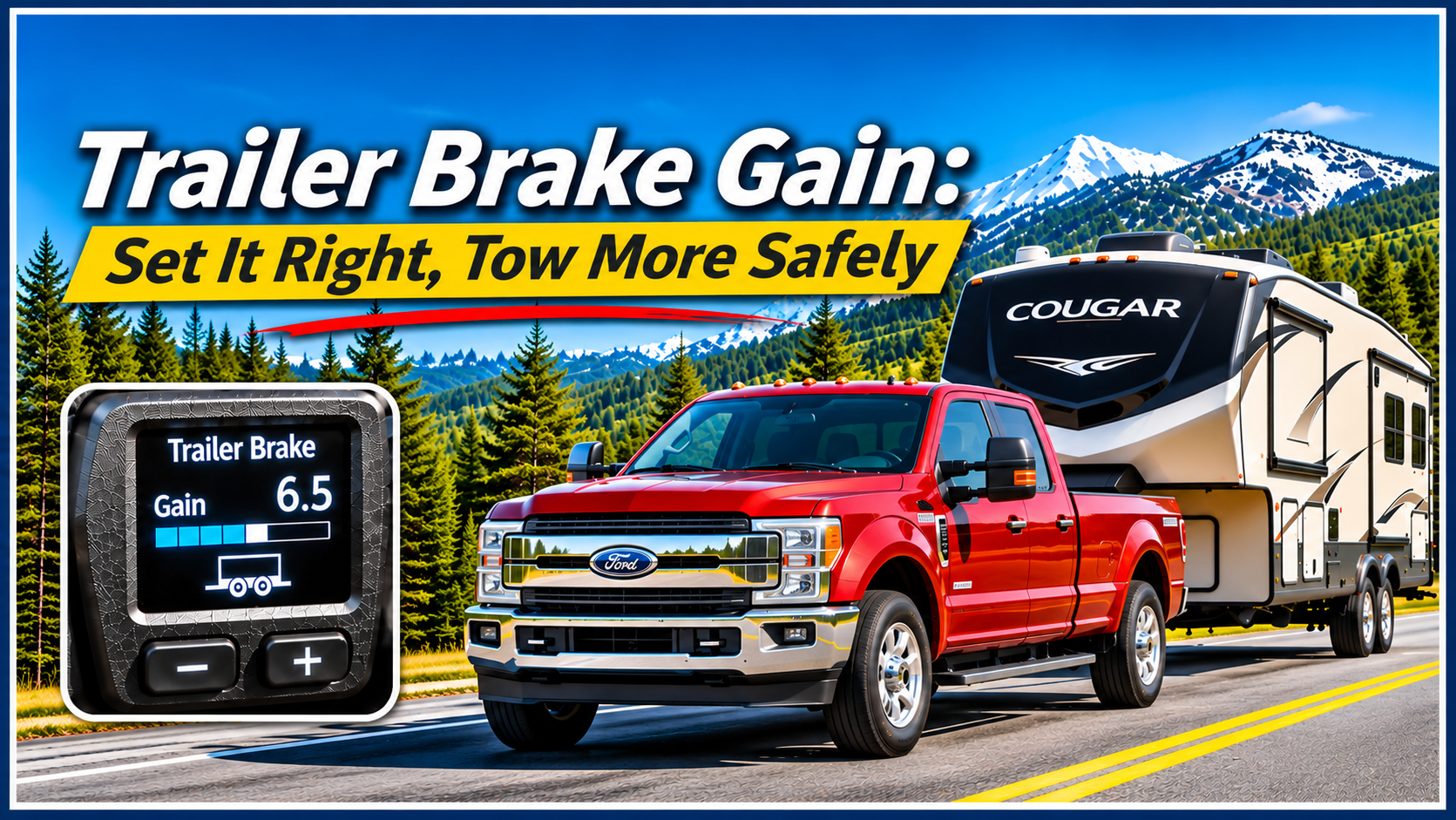
Trailer Brake Gain: Are Your Trailer Brakes Set Correctly?
When we talk about towing safety, much of the conversation centers around the tow vehicle. Does it have enough power to pull the trailer? Is it rated to handle the weight? Does it have enough braking capacity?
Those are all important questions, but there is another part of the equation that I don’t think gets enough attention: properly adjusting your trailer brake controller.
If you’re towing a travel trailer or fifth wheel equipped with electric brakes, your brake controller plays a critical role in how your combination stops. Having trailer brakes is one thing. Having them adjusted correctly is another.
And just because they were set correctly on your last trip doesn’t necessarily mean they’re set correctly today.
What Is Trailer Brake Gain?
Most modern pickup trucks designed for towing have an integrated trailer brake controller. Aftermarket controllers are also available for vehicles that don’t have one built in.
The controller regulates how much braking power is sent to the trailer’s electric brakes.
The gain setting determines the amount of braking output the controller can apply. On many controllers, it’s adjusted using a numbered scale, often from 0 to 10.
The higher the gain, the more braking power the controller can command. Lower settings reduce that power.
However, the gain setting isn’t necessarily a direct measurement of braking force. A setting of 7 doesn’t mean the trailer is receiving 70% of its available braking capacity. The actual output depends on the controller’s design and how it responds to braking.
The goal is to have the trailer brakes contribute appropriately to stopping the entire combination without locking the trailer wheels or allowing the trailer to push excessively against the tow vehicle.
Why Is Proper Brake Gain So Important?
Think about what happens when you’re towing a heavy trailer and need to make a sudden stop.
Your tow vehicle has its own braking system, but it shouldn’t be expected to do all the work of stopping both vehicles.
The trailer brakes need to do their share.
If the gain is set too low, the trailer won’t provide enough braking assistance. More of the stopping effort falls on the tow vehicle. That can increase stopping distances, accelerate brake wear and contribute to brake overheating, particularly on long downhill grades.
You may also notice the trailer pushing against the truck when you apply the brakes.
If the gain is set too high, the trailer brakes may apply too aggressively. That can cause jerky stops, excessive tire wear, wheel lockup and potentially a loss of stability, especially on wet or slippery pavement.
A locked trailer wheel cannot provide the same directional control as a properly rolling tire.
Neither situation is desirable.
Properly balanced braking helps the truck and trailer slow together in a controlled manner.
How Do You Properly Set Trailer Brake Gain?
First, understand that different brake controllers operate differently. The procedure in your tow vehicle’s owner’s manual, along with the trailer brake manufacturer’s recommendations, should always take precedence. You need to do your homework and understand how your system works and how to properly adjust it.
That said, the following is a common method used with many integrated and aftermarket electric trailer brake controllers.
Step 1: Make Sure Everything Is Ready
Before adjusting anything, confirm that your trailer’s electrical connector is properly connected and that the brake controller recognizes the trailer.
Make sure your trailer brakes are functioning correctly and that the trailer is loaded as it normally would be for travel.
Brake gain cannot compensate for worn brake components, improperly adjusted drum brakes, wiring problems or a malfunctioning brake controller. They should be inspected on a regular basis.
If you have conventional electric drum brakes, follow the manufacturer’s recommendations for brake adjustment and burnishing or break-in procedures.
Step 2: Find a Safe Place to Test
Find a level, dry, paved area with no traffic, pedestrians or obstacles.
An empty parking lot or another suitable controlled area may work, provided you have permission to use it.
Many brake controller manufacturers recommend performing the initial adjustment at approximately 20–25 mph. Check your specific controller’s instructions for the proper speed and procedure.
Step 3: Begin With a Reasonable Gain Setting
Start with the gain setting recommended by your tow vehicle or brake controller manufacturer.
For controllers without a specified starting value, use a moderate setting rather than immediately selecting maximum gain.
Remember that a heavier trailer does not automatically require the highest setting. Trailer brake design, condition, number of axles and loading all influence the appropriate gain.
Step 4: Test the Trailer Brakes
For many controllers, the recommended procedure involves driving at the specified low speed and applying the trailer brakes using the controller’s manual activation lever or switch, without applying the truck’s brake pedal.
The purpose is to evaluate the trailer’s braking response independently.
You should feel the trailer brakes slowing the combination smoothly and firmly.
If the braking feels weak, increase the gain slightly and repeat the test.
If the trailer wheels lock, skid or brake too aggressively, reduce the gain and test again.
The objective is strong, controlled trailer braking without wheel lockup.
Some controllers use different calibration procedures, so follow your particular manufacturer’s instructions rather than assuming every controller works the same way.
Step 5: Test Normal Braking
Once you’ve established an appropriate gain setting, perform several normal, controlled stops using the truck’s brake pedal.
The truck and trailer should slow smoothly together.
You shouldn’t feel the trailer repeatedly pushing the truck, nor should you feel the trailer brakes grabbing aggressively.
If something doesn’t feel right, investigate and make appropriate adjustments before heading out on the highway.
Don’t Forget the Trailer Brake Type
Not every trailer braking system works the same way.
Conventional electric drum brakes, electric-over-hydraulic systems and certain other trailer braking systems may require different controller settings or operating modes.
For example, some factory-installed controllers have separate settings for electric brakes and electric-over-hydraulic brakes.
Selecting the wrong mode can affect braking performance.
Always make sure the controller is configured for the braking system installed on your trailer.
Why You Should Check the Gain Regularly
This is something I think deserves more attention.
Once you’ve found a setting that works, it’s easy to leave it alone. But there are several reasons to check it again.
Trailer weight changes. A trailer loaded for a long trip may weigh considerably more than one being moved to a storage facility. Fresh water, waste tanks, cargo and other supplies all affect the weight the brakes must control.
Brake components wear. Electric drum brakes require maintenance, and many require periodic mechanical adjustment. As components wear, their braking response can change.
Road conditions change. A gain setting that works well on dry pavement may be too aggressive on wet, icy or otherwise slippery roads.
Repairs or maintenance have been performed. Brake adjustments, replacement components, tire changes or other work affecting braking performance may require another check.
The trailer has been sitting. After extended storage, it’s worth confirming that the brakes operate properly before beginning a trip.
You don’t necessarily need to perform a complete gain calibration every time you stop for fuel. But you should verify that the brakes are responding normally before each trip and recalibrate whenever conditions or braking behavior warrant it.
For our fifth wheel, I think of it as another part of the pre-trip inspection.
Don’t Rely on the Gain Setting to Fix a Brake Problem
Here’s another important consideration.
If you’ve been using a particular gain setting for years and suddenly need to turn it up significantly to get the same braking response, don’t automatically assume the solution is more gain.
It could indicate a problem with the trailer brakes.
Possible causes include worn brake shoes, improper drum brake adjustment, corroded wiring, poor ground connections, damaged magnets or other electrical and mechanical issues.
A controller showing that a trailer is connected doesn’t necessarily mean every brake is functioning correctly.
Increasing gain may temporarily mask a problem without fixing it.
If braking performance has changed noticeably, the trailer braking system needs to be inspected.
How I Handle Brake Gain on Our Fifth Wheel
With our fifth wheel, I try to do a formal brake gain adjustment at least once a year, usually at the beginning of the camping season. I follow the recommended procedure to make sure the trailer brakes are providing the proper amount of braking assistance.
Once we’re traveling, I pay attention to how the truck and trailer respond when braking. If I notice a change in how they feel, I’ll make minor gain adjustments as needed.
I don’t necessarily go through the entire adjustment procedure every time we’re on the road, but I don’t ignore changes in braking performance either.
One thing to remember is that if you suddenly need a significant change in gain to get the same braking response, it may indicate a problem with the trailer’s braking system rather than simply a need to adjust the controller.
For me, it’s about knowing how the truck and trailer normally respond and recognizing when something changes.
What About Going Down Steep Grades?
Properly adjusted trailer brakes are especially important when descending long grades.
But increasing gain is not a substitute for proper downhill driving techniques.
Select an appropriate lower gear before beginning the descent and use the tow vehicle’s engine braking or exhaust brake, if equipped and appropriate for the conditions.
Avoid riding the service brakes continuously, which can lead to excessive heat and reduced braking effectiveness. You should be using the tow vehicles engine braking system to do the majority of speed control on steep grades.
The trailer and tow vehicle brakes are designed to work together, but neither system should be unnecessarily overheated.
If you notice unusual braking behavior, a burning smell or signs of overheating, stop somewhere safe and investigate.
A Few Final Thoughts
We spend a lot of time talking about towing capacities, payload ratings, hitch weights and whether our trucks have enough power to handle our RVs.
Those discussions are important, but the ability to stop safely deserves just as much attention.
Your trailer brake controller is one of the most important pieces of equipment involved in that process.
Learning how it works, understanding the proper gain setting and periodically verifying that your trailer brakes are doing their job are simple steps that can make a significant difference.
And remember, the number displayed on your controller isn’t the important part. What’s important is how effectively and safely your truck and trailer work together when you apply the brakes.
Safe travels!
Rick’s Ramblings on RVing
Safety note: Brake controller operation and adjustment procedures vary by vehicle and braking system. Always consult your tow vehicle owner’s manual and trailer brake manufacturer’s instructions. Never perform braking tests in traffic or under unsafe road conditions.
Enjoy Rick's Ramblings?
If you found this post helpful or interesting, subscribe to receive an email when new posts are published.