RV Regulations: Don’t Believe Everything You Read on Social Media
If you spend any time on RV-related Facebook groups or other social media sites, you’ve probably seen posts warning about laws and regulations that supposedly affect RV owners traveling across the country.
Some of these posts contain useful information. Others contain outdated regulations, incomplete explanations, or statements that simply aren’t supported by the actual laws.
The problem is that once something gets posted, it gets shared over and over. Before long, people start accepting it as fact without anyone checking whether it’s accurate.
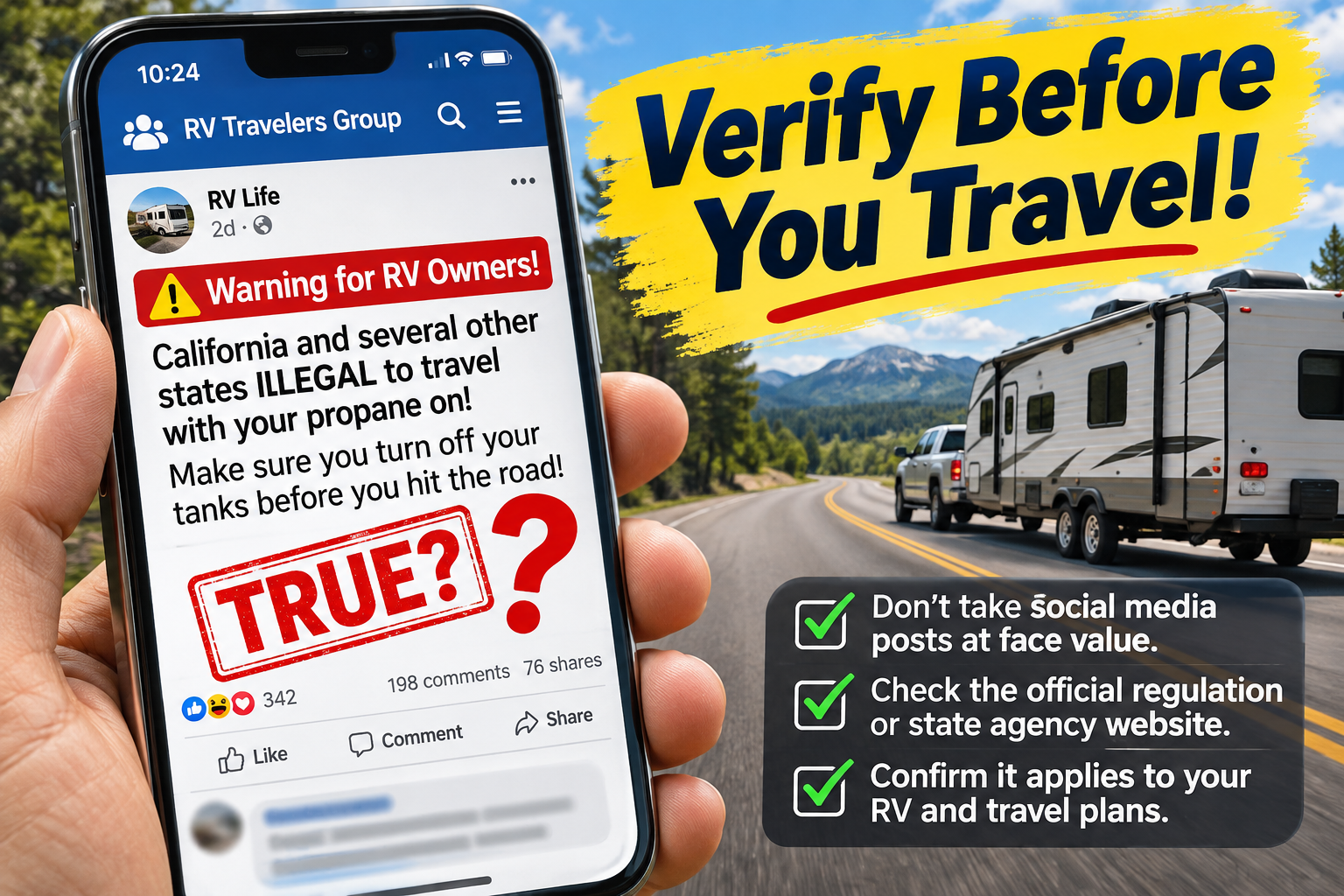
I recently came across another example involving traveling with propane tanks turned on to operate an RV refrigerator.
Is It Illegal to Travel With Your Propane Turned On?
I’ve seen social media posts and websites claiming that certain states prohibit RV owners from traveling with their propane tanks open.
That caught my attention because, like many RV owners, we have an absorption refrigerator that can operate on either electricity or propane.
I decided to do a little research to see what the actual regulations said.
What I discovered was interesting.
Several websites repeated claims that California and New Jersey prohibit traveling with propane turned on. But when I started looking for the actual laws supporting those statements, they weren’t nearly as easy to find.
In fact, an August 2026 investigation published by RVtravel.com contacted the California Highway Patrol about this very issue.
According to that investigation, the CHP confirmed that propane used for an auxiliary RV function, including refrigeration, falls under an exemption. The investigation also couldn’t verify the frequently repeated claim that New Jersey has a blanket statewide prohibition.
You can read the RVtravel.com investigation here.
That doesn’t mean there aren’t restrictions. There absolutely are.
Certain tunnels, bridges, and ferries have regulations concerning propane. Some require the tank valves to be closed, while others prohibit vehicles carrying certain propane containers altogether.
For example, Maryland has restrictions involving the Baltimore Harbor and Fort McHenry tunnels. The Chesapeake Bay Bridge-Tunnel in Virginia also has propane requirements.
But there’s a significant difference between a regulation applying to a particular tunnel and a law prohibiting RV owners from operating with propane turned on anywhere in an entire state.
And that distinction can easily get lost when information is passed around on social media.
The Same Problem Applies to Other RV Regulations
Propane is just one example.
I’ve seen similar posts concerning triple towing, RV length restrictions, driver’s license requirements, weight limits, tire chains, and braking requirements.
Sometimes the information is correct. Sometimes it applies only to commercial vehicles. Sometimes it applies to a particular road or crossing rather than an entire state.
And sometimes the regulation was changed years ago, but the original post keeps circulating.
I’ve talked with RV owners who knowingly travel through states where their towing configuration may not be permitted. Their reasoning is that their home state allows it, so they are willing to take their chances.
That can be a costly assumption.
States may recognize an out-of-state driver’s license, but that doesn’t mean every state must permit every vehicle configuration allowed in the driver’s home state. Equipment, size, weight, and operating restrictions can be different.
Depending on the violation, the consequences could be more than a citation. You could be required to change your route, disconnect a towed vehicle, or correct a problem before continuing.
That’s not something I want to deal with while traveling.
Do Your Own Homework Before You Travel
I’m not suggesting that every RV owner needs to become an expert on transportation law.
But if you see a social media post claiming that something is illegal, or that a state has special requirements for RVs, take a few minutes to verify it.
Here’s what I recommend:
- Look for the actual regulation. If someone claims a state prohibits something, see whether they provide a link to the law or regulation rather than another website repeating the same claim.
- Check the state’s official website. State departments of transportation, motor vehicle agencies, and highway patrol organizations are good starting points.
- Pay attention to who the regulation applies to. Commercial trucks, private RVs, motorhomes, travel trailers, and fifth wheels aren’t necessarily treated the same way.
- Check for local restrictions. Tunnels, bridges, ferries, mountain passes, and certain highways may have restrictions that don’t apply elsewhere in the state.
- Check the date. A regulation or article that was accurate ten years ago may not be accurate today.
- When in doubt, contact the responsible agency. A quick phone call or email can sometimes clear up a question much faster than reading dozens of conflicting opinions online.
And remember, just because several websites repeat the same information doesn’t necessarily make it correct. They may all be relying on the same outdated source.
There’s a Difference Between What’s Legal and What’s Safe
I also want to make one other point.
Just because something is legal doesn’t automatically mean it’s the safest choice.
Using propane to operate an RV refrigerator while traveling is a good example.
Even where it is legal, there are safety considerations involving propane systems, open flames, and refueling. RV owners should understand their equipment and follow the manufacturer’s instructions.
The same applies to towing near the maximum capacity of a vehicle, traveling in winter weather, or operating on steep mountain grades.
The law establishes certain requirements. Good judgment sometimes calls for going beyond those minimum requirements.
My Thoughts
Social media can be a tremendous resource for RV owners. I’ve learned a lot from other RVers over the years, and I’ve tried to share some of those experiences through this website.
But we need to remember that the person posting information in an RV group may simply be repeating something they read somewhere else.
They may have the best intentions in the world and still be wrong.
If a post tells you that something is illegal, ask where the law can be found. If it tells you something is legal, verify that too.
Don’t rely solely on Facebook posts, online forums, or even articles like this one when making decisions that could affect your safety or your ability to continue your trip.
I try to research the information I share here, but I also encourage readers to verify regulations themselves, particularly when planning travel through unfamiliar states.
The bottom line is simple: Use social media as a starting point for information, not as the final authority.
A few minutes spent doing your homework before leaving home could save you a ticket, an expensive mistake, or a major disruption to your trip.
Safe travels!
Rick’s Ramblings on RVing
Disclaimer: Regulations vary by state, jurisdiction, road, and vehicle type, and they can change. This article is intended to encourage RV owners to research applicable laws, not to provide a definitive legal interpretation. Always verify current requirements with the appropriate government agency or transportation authority before traveling.
Enjoy Rick's Ramblings?
If you found this post helpful or interesting, subscribe to receive an email when new posts are published.