Winter RV Travel: Tire Chain Laws and What You Need to Know Before Heading Out
Recent pictures of early-season snowstorms out west, along with posts from RVers heading out on their fall and winter trips, reminded me of a motorcycle trip my wife and I took years ago. It was an adventure we certainly hadn’t planned, but one that taught us a few lessons about winter travel.
We were in California for a work conference, and our friend Bob had joined us for the ride. The conference ended just in time, as an early winter storm was brewing in the mountains. We headed east toward Denver, hoping to stay a day ahead of the storm.
Mother Nature had other plans.
As we left a small town and headed toward Grand Junction, Colorado, the snow caught up with us. We were only about 10 miles outside of town, with more than 75 miles still to go before reaching Grand Junction. Knowing we would be climbing in elevation, we decided the smarter move was to turn around, head back to town and spend the night. Hopefully, the weather would improve by morning.
By the time we got back, conditions were approaching a whiteout.
The next morning, we woke to about four inches of fresh snow. Fortunately, the roads were still warm enough that much of the snow had melted off the pavement. We packed up and headed toward Grand Junction once again.
As we climbed higher into the mountains, we rode right back into the storm. Snow was beginning to accumulate on the road, and our speeds slowed considerably. Remember, we were on motorcycles, and I was even pulling a small motorcycle trailer.
Then we caught a break.
We came upon a tractor-trailer that had just finished putting on its tire chains. The timing couldn’t have been better. The driver pulled onto the highway just a few hundred yards ahead of us.
As I got closer, I noticed that his rear tandem tires were clearing two relatively snow-free tracks through the accumulating snow. I eased into those tracks and followed roughly 100 feet behind him. Bob followed along, and we continued climbing the mountain.
Despite the conditions, the motorcycles felt stable, and we were able to keep moving. I could see the truck’s mirrors, so I knew the driver was aware that we were behind him.
Once we crossed the final summit, the snow began to let up, the road cleared and we were able to return to normal speeds.
As we pulled out to pass the truck, the driver rolled down his window, gave us a big wave and sounded his air horns a couple of times. We waved back, acknowledging just how much his presence had helped us get through that stretch of road.
We made it to Grand Junction, but our adventure wasn’t over. We ended up stranded there for the remainder of the day and overnight.
Eventually, we decided that enough was enough. Once the storm had passed and the chain requirements were lifted, we rented a U-Haul, loaded the motorcycles inside and finished our trip to Denver on four wheels instead of two.
It wasn’t quite how we had planned to finish the ride, but it was certainly the safer option.
What That Experience Has to Do With RV Travel
That trip has stayed with me all these years, especially when I see pictures of RVs traveling through snow-covered mountain passes.
Watching that truck driver install chains, and then following the path his tires cleared through the snow, gave me an appreciation for how important the right equipment can be in winter conditions.
It also raises a question that RVers don’t always think about until they encounter a chain-control sign along the highway.
If you’re towing an RV and a state requires tire chains, what exactly are you required to do?
When RVers talk about winter travel, the conversation often turns to four-wheel drive, good tires and keeping an eye on the weather forecast. Those are all important, but there’s another consideration worth looking into before heading down the road: What does each state require when snow and ice move in?
Some states require certain vehicles to carry chains during a specified season on designated roads, even when the pavement is dry.
Others require chains to be installed only when weather conditions warrant and officials activate restrictions.
And in some situations, certain vehicles, including RVs and vehicles towing trailers, may be prohibited from traveling altogether.
Having chains in your truck doesn’t necessarily mean you’re permitted to continue down the road.
States RV Travelers Should Check Closely
California
Under posted chain controls, towing changes the rules.
Caltrans says vehicles towing trailers must have chains on one drive axle, even with four-wheel drive. Trailers equipped with brakes must also have chains on at least one axle.
Don’t assume that a four-wheel-drive exemption that applies to a pickup traveling alone also applies when you’re towing your RV.
Official Caltrans Chain Requirements
Oregon
Oregon’s usual allowance for traction tires instead of chains applies to qualifying vehicles rated at 10,000 pounds or less that are not towing or being towed.
When chains are required, towing configurations can require chains on both the tow vehicle and a braked trailer.
Oregon’s chain placement guide shows one chained tire on each side of one braked trailer axle for common light- and medium-duty towing configurations. Severe conditions can bring stricter requirements.
Official Oregon Chain Placement Guide
Washington
Washington has specific requirements for vehicles and combinations over 10,000 pounds GVWR.
On designated routes, sufficient chains must be carried from November 1 through April 1, or at other times when required. The regulations also call for at least two extra chains for vehicles over 10,000 pounds GVWR.
When chain controls are activated, common two- to four-axle towing combinations require chains on drive tires and one tire on the last trailer axle, with an allowance for either of the last two axles on tandem-axle trailers.
Washington provides diagrams showing chain placement for different vehicle combinations, so check the one that matches your equipment.
Official Washington Chain Regulation
WSDOT Chain Guidance and Placement Diagrams
Nevada
Nevada’s chain guidance specifically includes recreational vehicles and towing combinations.
Its towing instructions call for chains on one drive axle, even with four-wheel drive, and chains on the braking axle of a trailer equipped with brakes.
Vehicle weight and the posted restriction also matter.
Don’t assume California’s chain-control requirements mean exactly the same thing when you cross into Nevada.
Official Nevada Traction Requirements
Nevada Chain Placement Brochure
Colorado
Colorado’s chain laws expressly include private RVs.
Its published regulations place noncommercial RVs with a GVWR or GCWR of 16,001 pounds or more under commercial chain requirements when those restrictions are activated. Smaller RVs fall under passenger vehicle rules.
During a passenger vehicle chain law, chains or approved alternatives are required.
There’s an important complication here. Colorado’s published materials aren’t entirely consistent about seasonal chain-carry requirements for larger private RVs. One CDOT notice refers to commercial vehicles, while its signage guidance uses broader weight-based wording.
Owners of larger RV combinations should confirm the seasonal carrying requirements for their intended route directly with Colorado State Patrol before traveling.
Simply because your RV is privately owned doesn’t automatically exempt it from activated chain restrictions.
Official Colorado Chain Regulation
Colorado State Patrol Chain Information
Montana
When Montana activates chain or traction-equipment requirements, its guidance says vehicles towing trailers must chain the drive wheels of one axle.
A separate seasonal carry rule applies to towing units of 26,001 pounds GVW or greater from October 1 through April 30 in areas where chains may be required, with a stated four-wheel-drive exception to that carrying requirement.
That exception should not be confused with permission to ignore an active chain requirement.
Official Montana Tire and Chain Laws
Utah
Utah activates traction restrictions on designated roadways.
Its guidance calls for traction devices on all drive tires for vehicles over 12,000 pounds GVWR, with only one tire in each dual mounting needing a device.
Lighter vehicles have different tire and equipment options.
Check the active restriction and your vehicle’s classification before entering a controlled roadway.
Official Utah Traction Requirements
Wyoming
Wyoming uses two levels of chain restrictions.
Level 1: Allows vehicles equipped with chains, adequate snow tires or all-wheel drive.
Level 2: Is more restrictive, allowing chains or qualifying all-wheel-drive vehicles equipped with adequate mud-and-snow or all-weather tires.
Read the posted restrictions carefully rather than assuming every four-wheel-drive towing combination qualifies.
Pennsylvania
Pennsylvania is a good example of why winter travel restrictions involve more than just tire chains.
Under its Tier 1 winter restrictions, recreational vehicles, motorhomes and passenger vehicles towing trailers are prohibited from traveling on affected roadways.
Those vehicles remain prohibited under the higher restriction tiers.
In other words, carrying or installing chains doesn’t give you permission to travel when your type of vehicle is restricted.
Official Pennsylvania Winter Vehicle Restrictions
A Few Things to Check Before Heading Out
If you’re planning an RV trip through areas where winter weather is possible, there are several things worth doing before you leave.
- Check road conditions and restrictions. Use each state’s official transportation website or 511 service, especially when traveling through mountain passes.
- Know your weight ratings. Your truck’s GVWR and the combined rating of your truck and trailer may determine which requirements apply.
- Check your owner’s manuals. Not every truck or trailer can accommodate conventional tire chains. Clearance around tires, suspension components and brake lines matters.
- Know what equipment is required. Some states may require chains on both the tow vehicle and the trailer. Make sure any alternative traction devices you purchase are approved for your vehicle and the states you’ll be traveling through.
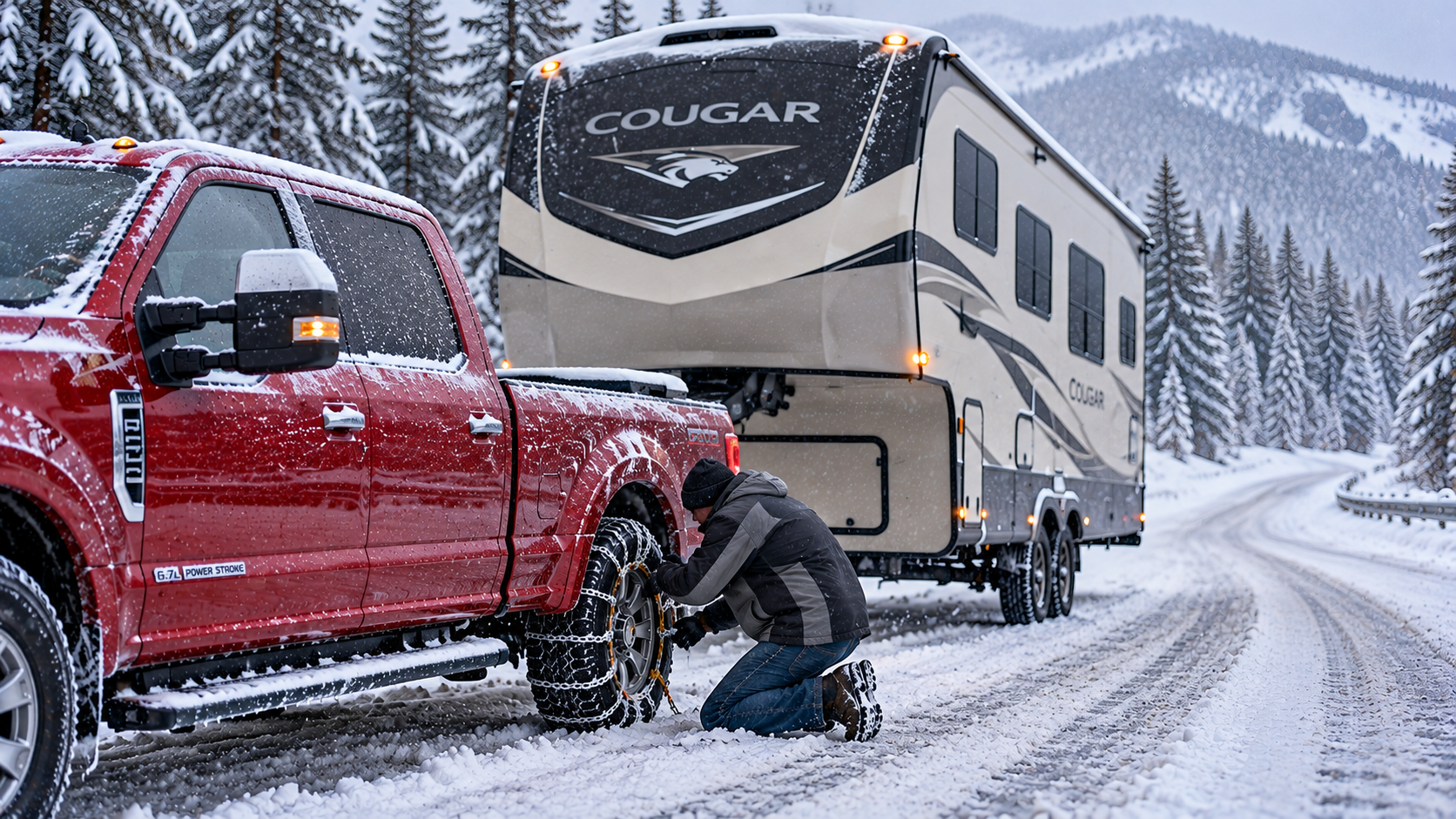
- Practice installing chains. The side of a snow-covered mountain highway is not the ideal place to figure out how they work for the first time. Check You Tube for video’s on how to put on your chains, but do practice as its not as easy when its cold and snowing so learn while you have time and good weather. Tire Chain installation video
- Have a backup plan. Sometimes the smartest decision is to find a safe place to stop and let the storm pass.
Sometimes the Best Decision Is to Wait
Looking back at our motorcycle adventure, we were fortunate. We made some good decisions, including turning around when the storm first caught us and eventually loading the bikes into a U-Haul rather than continuing to fight the weather.
We also caught a break when that truck driver came along. His chains helped clear a path through the snow, making a difficult stretch of road easier for us to navigate.
But I wouldn’t recommend relying on that kind of luck, especially when towing a large RV.
Today’s RVs are bigger and heavier than ever, and even a four-wheel-drive pickup can have difficulty controlling a heavy trailer on snow-covered or icy roads. Tire chains may improve traction, but they don’t eliminate the risks associated with winter driving.
A Quick Reminder: I’ve done my best to put together some useful information, but don’t rely on this article alone when planning your trip. Before you hit the road, do a little homework. Check the weather, look at road conditions along your route and make sure you understand the tire chain requirements for each state you’ll be traveling through. Rules and conditions can change quickly, so always check with the individual state’s transportation department for the latest information. A little planning ahead of time can save you a lot of headaches down the road.
The important thing to remember is that your home state’s rules aren’t necessarily the rules you’ll encounter when traveling elsewhere.
Before heading out, check the requirements for the states and highways you’ll actually be traveling through. Make sure you have the proper equipment, understand when it’s required and give yourself enough flexibility to change your plans if conditions deteriorate.
After all, there’s nothing wrong with spending an extra night somewhere waiting for better weather.
We learned that lesson years ago on two motorcycles in the Colorado mountains. It’s one that’s just as valuable today when traveling with an RV.
Enjoy Rick's Ramblings?
If you found this post helpful or interesting, subscribe to receive an email when new posts are published.