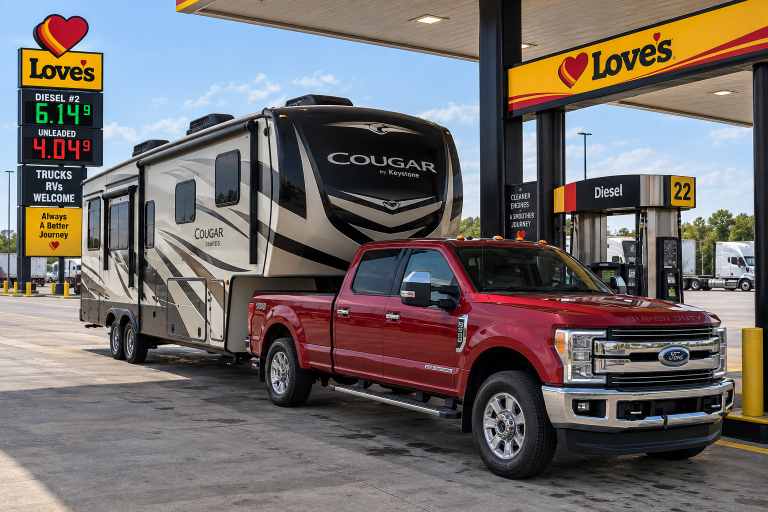

Fuel Prices Are Climbing Again, and I’m Paying Attention
Things are happening in the fuel industry around the world that have caught my attention.
A friend of mine follows several sources covering national and world events and has been sending me information about fuel prices and availability. Some of what he sent sounded pretty concerning. Rather than simply repeating what I was hearing, I decided to do some research of my own.
Unfortunately, there are some legitimate reasons to be concerned.
Here in Minnesota, I’ve watched diesel prices climb from around $6.14 per gallon to $6.44 or more in less than two weeks. For those of us traveling with diesel pickups and RVs, increases like that get our attention pretty quickly.
But this isn’t just an RV or diesel-owner problem.
Diesel Prices Affect Almost Everything
You don’t have to own a diesel vehicle to be affected by the price of diesel.
Diesel powers much of the equipment that moves the products we buy. Trucks, farm equipment, construction equipment and other parts of our transportation and agricultural systems depend heavily on it.
Those industries can’t simply absorb dramatically higher fuel costs indefinitely. Eventually, at least some of those additional transportation and production costs make their way into the prices consumers pay.
That’s why I’m watching diesel prices as more than just the cost of filling our F-350.
Diesel Supplies Are Tight
One of the more concerning things I found is what’s happening with U.S. diesel inventories.
According to the U.S. Energy Information Administration’s September forecast, U.S. inventories of distillate fuel oil, which includes diesel and heating oil, are expected to fall below 100 million barrels and remain below the five-year low through much of 2027. The EIA specifically says low inventories are contributing to higher domestic diesel prices. (U.S. Energy Information Administration)
That doesn’t mean we’re about to run out of diesel.
In fact, the latest weekly report showed some rebuilding of fuel inventories. But we’re starting from unusually low levels, and the overall market remains tight. (BOE Report)
The situation isn’t limited to the United States. International diesel supplies have also been disrupted. Russia, normally a major diesel exporter, has restricted exports, and disruptions in the Middle East have reduced petroleum and refined-product supplies reaching world markets. (Reuters)
We’re Still Exporting Diesel
This is one part of the situation that I find particularly interesting.
While U.S. diesel inventories are unusually low and we’re paying extremely high prices at the pump, the United States continues exporting large quantities of diesel and other distillate fuels.
According to the EIA, the U.S. exported about 1.6 million barrels per day of distillate fuel during the week ending September 11. The EIA also says tight international supplies and high global prices are encouraging increased U.S. exports. (U.S. Energy Information Administration)
That has led to discussion about whether the United States should restrict exports to keep more fuel here at home.
There are arguments on both sides. Keeping more diesel here sounds pretty appealing when we’re paying more than $6 per gallon, but the petroleum market is global, and restricting exports could have unintended consequences.
I’m certainly not enough of an economist to tell you which side of that argument is right.
I do think it’s a discussion worth following.
Costco Is Even Limiting Motor Oil
Another development caught my attention because it isn’t directly about fuel at the pump.
Costco has placed purchase limits on some motor oils. Its Kirkland Signature full-synthetic motor oil is currently limited to two boxes per membership per week. Costco has also limited purchases of some Mobil 1 synthetic oil. (AP News)
I don’t want to make more of that than it is.
This isn’t gasoline or diesel rationing, and I haven’t found evidence of widespread fuel rationing at U.S. gas stations.
But it is another indication that what’s happening in petroleum markets is beginning to affect products beyond the numbers we see on gas station signs.
What Does This Mean for RV Travel?
This is the part we’re watching closely.
I’ve noticed something interesting in several of the RV groups I follow. Some owners renting RV sites in the South appear to be reducing their monthly rates to attract renters.
One location I’m very familiar with was asking around $1,300 per month last fall. Comparable sites there are now being advertised for around $800 per month.
That’s anecdotal. One location certainly doesn’t establish a national trend.
But it makes sense. For an owner, $800 per month may be better than having an empty site producing nothing.
There’s another side to that equation for RVers.
If you can save $500 a month on your winter site, that savings can offset quite a bit of additional fuel expense getting there. Someone traveling on a budget may decide the trip still works financially even with $6 diesel because they’re saving substantially at their destination.
That’s the kind of calculation I suspect more RVers will be making if fuel prices remain where they are.
We’re certainly doing it.
We’re Watching Closely
I’m not writing this to suggest everyone should run out and fill every fuel can they own. Panic buying and hoarding would only make a tight supply situation worse.
I’m also not predicting that we’re going to run out of diesel.
What I am saying is that there are enough warning signs that I’m paying attention.
Diesel inventories are unusually low. Fuel prices have risen dramatically. International events are disrupting petroleum production and transportation. Russia is restricting diesel exports. The United States continues exporting significant amounts of distillate fuel while our own inventories remain tight. And we’re beginning to see higher petroleum costs affect products beyond the fuel pump.
For us, it means looking more carefully at our travel plans and our budget.
I hope things stabilize soon and fuel prices begin moving back toward something resembling normal.
We’ve weathered fuel-price spikes before, and markets eventually adjust. But dramatic increases like this don’t affect only those of us standing at a diesel pump filling a pickup or RV.
Eventually, we all pay for them.
Sources and Further Reading
U.S. Energy Information Administration — September 2026 Short-Term Energy Outlook
The EIA’s current outlook covers U.S. distillate inventories, international supply conditions, exports and diesel-price forecasts. It forecasts inventories falling below 100 million barrels and remaining unusually low through much of 2027. (U.S. Energy Information Administration)
EIA Short-Term Energy Outlook
U.S. Energy Information Administration — Weekly Distillate Exports
The EIA’s weekly data show U.S. exports of approximately 1.6 million barrels per day of distillate fuel for the week ending September 11, 2026. (U.S. Energy Information Administration)
EIA Distillate Export Data
Associated Press — Costco Motor Oil Purchase Limits
AP reported September 14 that Costco increased prices and imposed purchase limits on Kirkland Signature and some Mobil 1 synthetic motor oils. (AP News)
AP: Costco raises motor-oil prices and limits purchases
Reuters — International Diesel Supply and Russian Export Restrictions
Reuters reported September 16 on Russia’s plans to extend diesel-export restrictions through October amid the broader tight global diesel market. (Reuters)
Reuters: Russia extends diesel export restrictions
Reuters — Current Global Oil and Diesel Market
Reuters reported September 16 on continuing Middle East disruptions, reduced Russian refinery output and the resulting pressure on global diesel supplies and prices. (Reuters)
Reuters: Global oil and diesel market update