
Bad News on Fuel Prices: High Diesel Prices May Be With Us Into 2027
Unfortunately, there isn’t much good news on the fuel-price front.
Reuters reported today, September 21, that what many had hoped would be a relatively short-lived spike in diesel prices may last considerably longer. Industry analysts now believe the global diesel shortage could continue well into 2027.
That’s not good news for RVers, and it’s certainly not good news for the U.S. economy.
Diesel powers much of the trucking industry that moves the products we buy every day. Trucking companies can’t simply absorb dramatically higher fuel costs indefinitely. Those expenses eventually work their way through the supply chain and into the prices paid by businesses and, ultimately, consumers. Reuters recently estimated that diesel accounts for about $51 billion of the $112 billion increase in U.S. fuel spending since the current conflict began.
Supplies Remain Tight
The inventory numbers help explain why prices aren’t expected to return to normal quickly.
U.S. distillate inventories, which include diesel and heating oil, have fallen to extremely low levels. Reuters reports that U.S. inventories are at their lowest September level since 1982. The EIA reported about 107.9 million barrels of distillate inventories for the week ending September 11.
The problem isn’t simply the amount of crude oil available. Conflicts in the Middle East and disruptions to Russian refining have reduced global supplies of finished diesel fuel. Reuters reports that analysts expect those conditions to keep inventories unusually tight into 2027.
There are currently no U.S. restrictions on diesel exports, but that idea is being discussed. Iowa Senator Chuck Grassley has publicly called for an embargo on U.S. diesel exports in response to the high prices being paid by farmers and other diesel users. Whether restricting exports would actually lower prices without creating other problems is another question, and the administration has so far resisted the idea.
What Does This Mean for RVers?
Here in Minnesota, we’re seeing diesel hovering just below $6.50 a gallon, while regular unleaded is around $4.40 in our area.
I’ve been following discussions about diesel prices on RV social media groups. Most of the people commenting say the higher prices aren’t going to change their travel plans. They’ll simply pay the additional cost and continue traveling.
That’s certainly one approach, but it won’t work for everyone.
I may be making too broad an assumption, but some people traveling in expensive Class A and Class C motorhomes may have more room in their travel budgets to absorb these increases.
We’re not in that category.
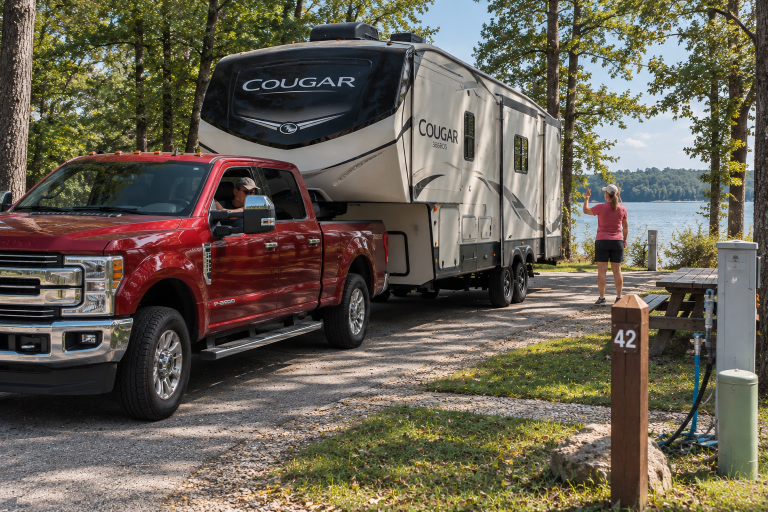
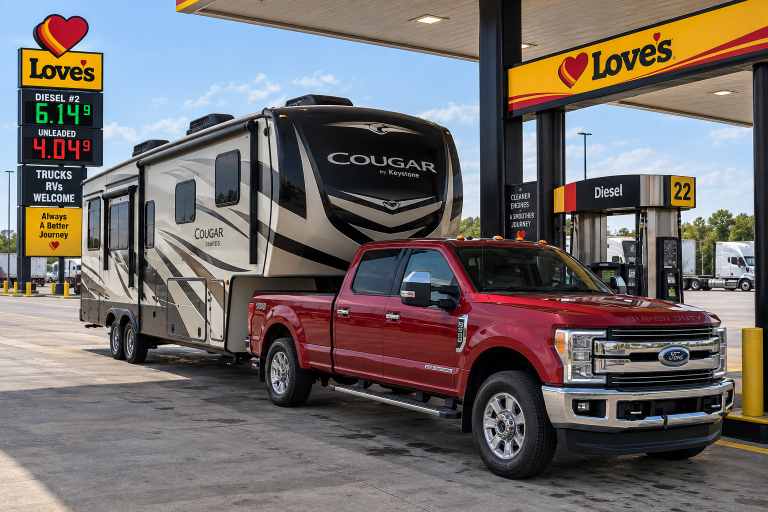
Diesel is now more than $2 a gallon higher than it was on our last major trip. When you’re towing a large fifth wheel and getting around 9 miles per gallon, an increase of $2 a gallon isn’t something you simply shrug off.
It will affect our travel planning.
That doesn’t necessarily mean we stop traveling. It means something else in the budget has to give.
One thing we can do to soften the blow is take advantage of every fuel discount available to us. We use both Open Roads and Mudflap, and while neither one is going to make $6-plus diesel cheap, the savings add up when you’re putting a lot of fuel into a truck pulling a fifth wheel. I’ve written before about the fuel discount programs we use and how they work. If you’re traveling with a diesel RV or tow vehicle and aren’t using a discount program, now would certainly be a good time to look into one.
One place we’ll be looking is campground costs. If we’re spending hundreds of dollars more on diesel during a trip, we’ll have to look harder for lower-cost campsites to help offset some of that additional fuel expense.
Interestingly, I’ve already noticed some campgrounds advertising rates that appear to be lower than what they were charging last year. Whether that’s an early indication of softer demand or simply individual campgrounds adjusting their pricing is impossible to say yet.
This Winter Will Be Interesting
One thing I’m particularly interested in watching is the annual migration of RVers and snowbirds to warmer parts of the country this winter.
Will people simply absorb $6-plus diesel and continue traveling exactly as they always have?
Will they take shorter trips?
Will they stay longer in one location rather than moving around?
Will campground operators have to adjust their rates if fewer RVers are traveling?
I don’t know yet.
But if diesel prices remain anywhere near their current levels through the winter and into 2027, I have a hard time believing there won’t be some effect on RV travel.
For us, the answer won’t necessarily be to park the fifth wheel.
It will be to travel smarter, watch campground costs more carefully and make sure the trips we take are worth what it’s going to cost to get there.
Enjoy Rick's Ramblings?
If you found this post helpful or interesting, subscribe to receive an email when new posts are published.