Blow Out
It is amazing how quickly the miles add up on an RV.
We bought our fifth wheel in January 2020, just before COVID changed everything. That first year we only managed one camping trip. Campgrounds were either closed or only accepting seasonal campers, so what was supposed to be a busy first season never happened.
Fast forward a few years and we were headed to one of our favorite places, Burlington Bay Campground in Two Harbors, Minnesota.
As part of my pre-trip inspection, I checked the truck’s towing information screen. One of the items it displays is the trailer mileage. Casa Roll, as we call our Cougar, had just over 10,400 miles on it.
At first, that number surprised me. Then I started thinking about our trips to Sturgis, our first winter as snowbirds in Florida, and all the camping we’ve done throughout Minnesota and Wisconsin. Suddenly, it didn’t seem like that many miles at all.
During my inspection, I noticed one trailer tire was about six pounds low compared to the others. The trailer had been sitting for about a month while we settled back into life in Minnesota after wintering in Florida. I didn’t see any visible damage, so I aired it back up and continued with our departure.
We also have a Tire Pressure Monitoring System (TPMS). Unfortunately, I forgot to turn on the repeater that’s mounted in the trailer. It’s wired directly to the battery and requires a small switch to be turned on before traveling.
That was my mistake.
The drive north was windy, with strong crosswinds and quartering winds most of the way. About 100 miles into the trip, I felt something different. Instead of the truck and trailer moving together in the wind, it felt like only the trailer was pulling to the right.
I eased off the throttle and looked in my mirror.
At first, it looked like small rocks were being thrown from the right side of the trailer. As I began slowing down, smoke appeared.
Within less than a minute, we were safely stopped on the shoulder of Interstate 35.
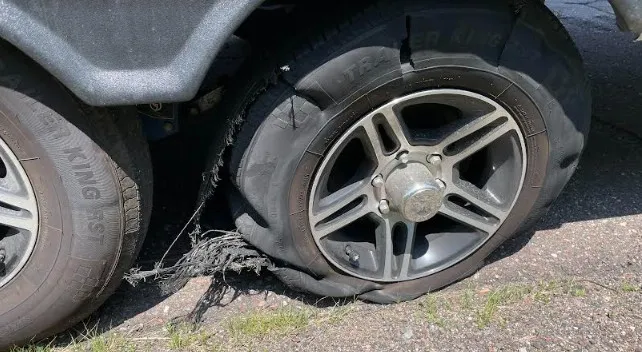
The front trailer tire had completely blown apart.
Thankfully, the rear tire was still intact.
This was our first roadside breakdown with the fifth wheel, and of all the things we expected to deal with that day, ticks weren’t one of them.
The shoulder was bordered by tall grass, and the ground was crawling with ticks. There was only about two feet between the trailer and the weeds, and every time either of us stepped near the grass, we picked up more ticks. I pulled four off myself within the first few minutes.
With traffic flying by at highway speeds, we got to work.
As always seems to happen, the tools we needed were buried in the truck and trailer. After digging everything out, we set up our warning triangles and started changing the tire. Pat kept an eye on traffic while helping me gather tools and equipment.
Fortunately, the blowout was on the passenger side. Even with the ticks, it was far safer than working next to traffic.
One unexpected problem was that the axle sat too low for my bottle jack to fit underneath. I first used the truck’s screw jack to raise the trailer enough to slide the bottle jack into position. Using wood blocking under both jacks and alternating between them, I was finally able to lift the trailer high enough to install the spare.
About an hour later, we were back on the road.
To celebrate, we stopped at Gordy’s Hi-Hat in Cloquet, one of our favorite places to eat whenever we’re in the area. We had planned to stop there anyway, but after changing a tire on the side of the Interstate, lunch tasted even better.
Before leaving, I checked the lug nut torque one more time and we completed the drive to Two Harbors without any additional problems.
Every experience teaches something, and this one was no exception.
We learned just how quickly things can happen. At 65 mph, less than a minute passed between the first sign of trouble and coming to a complete stop.
I also learned that a battery-powered impact wrench is worth every penny. Without it, changing that tire on the shoulder would have been much more difficult. What we didn’t have was a lug wrench designed specifically for the trailer wheels. That has since been added to our tool kit.
Most importantly, Pat and I discovered once again that we make a pretty good team when unexpected things happen. As she likes to say, “Teamwork makes the dream work.”
The other lesson was one I should have known already.
Always turn on the TPMS.
Would it have warned us before the tire failed? I’ll never know, but it certainly would have given us more information.
The tires were now over four years old and had accumulated more than 10,400 miles, not counting the miles traveled from the factory to the dealership before we ever owned the trailer.
That evening I spent some time researching trailer tire life expectancy. Even though the tread still looked good, I realized we were nearing the end of their recommended service life. Tire age and accumulated miles are just as important as tread depth.
Our plan was to replace the damaged tire immediately and replace the remaining tires once we returned home. We only had about 150 miles left before getting back, but after experiencing one blowout, we knew another could happen at any time.
This time, the TPMS stayed on.
One thing both of us noticed during the repair was how many drivers moved over into the left lane as they passed us. That simple act made working on the shoulder much safer, and we’re grateful to everyone who did it.
We were also thankful that we had most of the tools we needed, avoided waiting hours for roadside assistance, and that the damage to the trailer appeared to be limited to the wheel well.
Sometimes I wonder if I carry too many tools.
Then something like this happens.
I’ve always tried to think through the “what if” scenarios before every trip. This experience reminded me that there’s always another “what if” to prepare for.
Keep an eye on your tires. Don’t just look at the tread. Pay attention to tire age, air pressure, and the miles they’ve traveled.
A few minutes of inspection before leaving home may prevent a much bigger problem down the road.
Enjoy Rick's Ramblings?
If you found this post helpful or interesting, subscribe to receive an email when new posts are published.